Featured Articles

Featured Articles

Billions of people in the world are bilingual and even multilingual. It is not unusual for people in India or Africa to speak four or five languages. Why should it be so difficult for missionaries to learn a new language or two? Perhaps we are going at language learning in the wrong way. The normal procedure for our missionaries is Bible college, deputation, and then a language school on their chosen field. There is a vitally important step that is usually overlooked: pre-field linguistic training such as has been available for Baptist missionaries at BBTI for nearly fifty years. Some have greatly benefited from it, however, the vast majority have either not known of its existence or chosen not to take advantage of it.

The language school method of language learning presupposes that a school is available for the language the missionary needs to learn. Language schools teach trade languages such as French, Portuguese, Spanish, Swahili, Arabic, Russian, Chinese, Japanese, Korean, etc. There are 7,151 languages in the world, and it would be safe to say that 6,000 or more of them have no language schools. Yet there are billions of lost souls that speak these languages: souls for whom Jesus died, souls that He desires to save, and souls that deserve to hear the message in their heart languages. Some of these languages have only a few hundred speakers while others have several million. With few exceptions, our Independent Baptist missionaries are not attempting to reach people whose languages have no schools because of the seemingly impossible language barrier. Many of these languages are still unwritten which of course means they have no portion of God’s Word. An estimated eighty-five percent of our missionaries go to only fifteen countries and then only to the major trade languages. Most of these countries have several other language groups. For instance, in the African country of Côte d’Ivoire, there are 77 languages besides the official French. Would you not agree that all people deserve to hear the Gospel in the language they understand best, just as we did?

A language school where one is available is a good idea but not when the missionary first arrives on the field. We suggest that he begins vigorously learning the language from the people and progress to a point of fluency in a more natural way. Schools are not the natural way to learn languages. We did not learn our first language in one! The method of language learning that we suggest may sound radical to Americans, but it works, and it is usually better and faster. This plan will require extreme dedication and diligence on the part of the missionary. If he is too undisciplined or unwilling to take on this responsibility and become a learner, leaving behind the mentality of a student, then he should simply go the language school route and live with its results and limitations.

We are not suggesting that the missionary simply go out with the people and “pick up the language” the best he can. No, we are suggesting a plan that involves a tried and proven method. The missionary can go to the field with this method and begin using it upon arrival. But he must learn the method here first. Before you ask, the answer is no; he cannot learn it on the internet. And it will take time. (Missionaries spend the necessary time to prepare theologically in Bible college and financially on deputation. Why should they not spend the necessary time to prepare linguistically?)

This natural language learning method is part of the overall nine-month Advanced Missionary Training (AMT) program of BBTI which provides many language and culture learning tools that are not available in Bible colleges. The first skill we teach is phonetics. I have said it a thousand times; one more time will not hurt: No missionary should attempt to learn a new language without first studying phonetics! (At BBTI both husband and wife take the same classes.) Students spend at least one hundred fifty literal classroom hours learning to recognize and reproduce any sound they may encounter (there are about eight hundred of them). Because he learns to produce the new sounds exactly as the native speaker, he can speak a new language with little or no foreign accent. An accent does not disappear with time; from the beginning, he must keep from superimposing his English habits on the new language by forming new habits that will last for life.

The missionary student uses his newly acquired phonetic skill for a following course, Situational Language Learning. This includes using a language helper (I did not say a language teacher) who speaks a foreign language well. (In recent years, we have used Sina-Sina from Papua New Guinea, Japanese, Korean, Khmer from Cambodia, and Spanish.) The student learns how to elicit the language from the helper in a step-by-step process, beginning with simple object-like words and slowly increasing the length of the utterances. In a short time, he is fluent in all the sounds of that language. In a few weeks, he, along with a partner, will progress to eliciting and learning dialogues natural to the native culture such as buying food in the market. If his target language has no language school, he can continue using this method for as long as needed. If a language school is available, he can enter it after a few months and advance rapidly in grammar and more vocabulary. He begins at the top of the class because he is not struggling with pronunciation. He will sound like a native. Speaking and acting like a native should make him much less of an outsider. He will be comfortable with the people and hopefully they will be more willing to listen to his message. They may even tell him, “You eat our food, you spend time with us, you talk like us. Hey, you are one of us!”

The ground is level at the foot of the cross, meaning that all are welcomed and received equally when they come to God through faith in Jesus Christ. Jesus made a full and final atonement for the sins of Adam and all his descendants. Not only does God desire that all would arrive at the cross (1 Timothy 2:4), He commands it (Acts 17:30). The ground is indeed level at the foot of the cross, but the road leading there is not. For some there are seemingly insurmountable obstacles along the way.

To the place I heard the Gospel for the first time, I drove one mile on a paved road. I passed no checkpoints, and no armed guards asked where I was going. I walked into the building in broad daylight. It was not an underground church service. I feared no retaliation from a religious system. No family member opposed my going or persecuted me afterward. I heard the message in my language without it going through an interpreter. If I did not know better, I might think God loves me more than most people in the world. For me, the road to the cross was smooth and easy. I wish it were for everyone.

Most in the world know nothing about the cross or that there is even a road to it. No one gets to the cross without the message of the Gospel, and it simply has not been declared where they live. Contrary to God’s will, these poor souls live and die without the Gospel.

Another huge obstacle is social control, commonly called peer pressure. A society keeps its people in line with the threat of punishments. Punishment might be mild like gossip or ostracism or as serious as death. We have heard of a father killing his child that converted to Christianity. It is much easier to get to the cross from North Carolina than from North Korea! The fear of exile from a family or group is terrifying. A Muslim in Indonesia told a BBTI graduate, “I am an Indonesian, a Sunda Muslim. If I trust Christ, I am no longer a Sunda. If I am not a Sunda, I am nothing. I have no home, no family, no house, no relationship. I know I am a sinner, and I do not want to be punished for my sins. I know Jesus Christ is the Savior of the world, but I would rather risk suffering eternally in the lake of fire than to lose my social identity in this life.” (Missionaries in these difficult places are not going to see quick results; we need to be patient with them.)

To illustrate this difficult struggle against social control, consider the following from BBTI graduate Emanuel, who along with his wife, Courtney, works with Afghan refugees in Greece:

“Iman is not like the normal Hazara Afghans that are the majority here. In fact, there is a lot of fighting between Iman’s Panjshir group and them. Iman says they all convert easily because they don’t take their religion seriously. They will change again later from Jesus to something else when the situation affords. Iman on the other hand owns his faith. He has a very strong national pride that relates to his religion…But then here comes the dichotomy. For all this die-hard insistence, in the same conversation he will confess that he is tired of religion and wishes there were a way to connect with God directly without going through books, prophets, and go-betweens.

Over the weeks, we have had many conversations about the identity of Jesus. We showed him many scriptures, each of them shedding more light, but still, he would insist that he cannot accept that Jesus is God. We learned not to press the point. Instead, we befriended him, along with many others. We built trust, and he started coming and reading the Bible. When his younger brother was missing for days, we prayed with him. We let him talk about his life, his brothers who are fighting the Taliban, his mother whom he loves more than any other person, the three cows they have, the customs and values they live by, the climate of his mountain home, why he left it, the challenges along the way, and how he misses his family. For every hour we have spent teaching, we have spent as much listening. Slowly he was drawn in.

Now, he enjoys the Bible more and interacts with it better than most Christians I know. I can give him a passage, and he will read it and then preach it to me. He would make a great preacher. He loves Jesus… Still, he could not accept Christ’s identity. Until recently that is.
The other day we had a God-ordained hour with him, showing repeatedly that Jesus was in fact worshipped by men and angels, that he not only permitted it, but God commanded it, and that one day every tongue, including Iman’s, will confess that Jesus is Lord. At the end, he confessed that he believes it is true, but he has a family, which I suspicioned, for all his claims of independence, was the real reason he could not accept Jesus as the Son of God. If Jesus is right, his family, his nation, his heritage, has been mistaken for hundreds of years. That is an incredibly hard pill to swallow for one who is not bitter and hurt by his native culture, but proud of it…For such a person to become a follower of Jesus, what must he lose? Father, mother, brother, and sister, yes, Islam. He must find a new reference point, with new values, new beliefs, a new community, a new Lord and Master, a new Book, a new road, a new everything. Nothing old can stay the same. All that is dear to him must be eclipsed by One who beckons to him with nail scars in his hands and feet.”

It was easy for me to accept Jesus. I did not lose my family, my job, or my country. Not so for many. What will it take to get people like the Sunda Muslim or Iman down the road to the cross? Someone must obtain specialized training for the task. He must give up all he knows and loves and go to where they live, he must patiently learn new tongues and cultures, and he must not look for shortcuts or quick results. He must be willing to walk a difficult, dangerous road with the seeking sinner until they reach the level ground at the foot of the cross.

Spring 2022

Understanding of a people’s culture is vital. If the missionary does not know the culture, he is likely to deliver a confused message. The following article by a BBTI graduate, whose identity we must conceal, demonstrates this fact. Understanding of a people’s culture is vital. If the missionary does not know the culture, he is likely to deliver a confused message.

In the process of language learning, we have heard several folktales and children’s stories and have learned much about the people’s cultural mindset and worldview. We have seen at least three common themes.

Firstly, people are collectivists, NOT individualists. In America, we have been rooted in humanism to the point that “I define me.” In other words, I get to decide what I think is right and wrong. In general, westerners want to stand out of the crowd, be their own person, and have their own opinions. It does not work that way here. A person’s goal in a collectivist society is to progress the community; all are equal, and everyone is happy. Nobody has more than anyone else, we are all one big family, and what is mine is yours. This could explain why communism, to a certain point, makes sense here culturally. It is when the people discover that the dictators are above everyone else, have more, and are bossing people around that things begin to change. Which brings us to the next point…

Authority (without reason) is almost always resisted and rebelled against. If others (the pu-nyai) are over you, they are expected to show respect and understanding to you and everyone else (the pu-noi) under them. This means that if you give a rule, you should also explain why that rule is being enforced. Giving a reason shows you care about others and are helping to further everyone so that all live in unity. Otherwise, you are just a jerk full of pride scolding the underlings.

Last of all, deception is considered heroic. A typical hero in a folktale is an underling (pu-noi) who deceives the dictator/jerk (pu-nyai) in order to shame him, make him “lose face” in the community, and bring down his pride. We have seen this pattern over and over in these stories. A clever trick played on someone, usually in a humorous way, shows not only how the trickster does not like the jerk, but that he thinks the jerk is something he should not be. It is a way to “get the upper hand” so to speak. Here is an example of a story involving these things:

“Please don’t put me in the bucket!” called a soft voice.
“Oi! The fish can talk!” the lady said with a startle.
“Please don’t put me in the bucket!” the little fish begged again.
“But if I don’t catch you, I will not have anything to eat!”
the lady replied.
“But I am so young and very small,” implored the fish. “You will not have enough to eat. Why don’t you put me back in the water and wait until I am fully grown? Then you can catch me again, and you will have more to eat for that meal.”
After some thought, the lady conceded. She gently placed the little fish back into the river.
The little fish, happy to be free again, swam and splashed as far away from the net as he could, determined to
never return to that spot in the river.

Here we observe the pu-nyai, the lady who will catch and eat the fish (which only benefits her and leaves no mercy for the fish). The pu-noi, the little fish, resists and outsmarts her, even lying to her that he will be there again for her to catch once he is grown up. His trickery saves the day, he swims free (a small victory for all fish everywhere), and the woman is assumed to go hungry that day.

How does this affect the missionary? Take, for instance, the story of Adam and Eve. At first, if you hear the story through our people’s ears, God could
be considered a bad pu-nyai, giving rules without reason; the hero of the story would be the serpent, Satan. In deceiving Eve (by mixing truth with lies), he really deceived God and foiled His plans. And now all the earth and humankind are as corrupt (thus on the same level) as Satan. Imagine trying to convey the Gospel when Satan is seen as the hero!

However, if we show that God is a good pu-nyai, giving reasons for his rules (“In the day that thou eatest thereof thou shalt surely die.”), thus trying to look out for and protect the pu-noi under Him, we see that deceiving Him is the worst blasphemy ever! Now, the deceiver is harming the one that protects the community, making himself the pu-nyai who is getting something only for himself and hurting everyone else. It shifts the situation entirely.

Now consider Christ Jesus. He was and is THE Pu-Nyai: Creator God, holy, sovereign, all-powerful, eternal, worthy of all praise. He stooped down and became a humble Pu-Noi. He had no more than anyone else around Him; He roamed homeless, often only finding solace on the Mount of Olives. He helped make the lives and souls better for those around Him. He had compassion on His fellow men. He did not come as Pu-Nyai, even though He is worthy to make the rules. He came as one of us, so He could be accepted by us.

As missionaries, we MUST be learners before we can be teachers, or we will find ourselves having to correct grave errors in our teaching. We cannot just spread the Gospel without giving due attention to culture. The way we pre- sent things may or may not make sense to the hearers. We must be pu-noi, just humans among fellow humans, serving our Heavenly Father, the Pu-Nyai of pu-nyai, the holiest and worthiest of all.

This title comes from an article by Paul Fleming. It makes us laugh but should make us cry. In practice, a lot of men are saying, “Send my sister.” Fleming goes on to write:

We men! We are the stronger sex; it has always been so! We send our gifts to mission fields, to which the women go. While up the steepest jungle paths, a woman bravely treads, We men, who are the stronger sex, do pray beside our beds. When women leave to go abroad, the heathen souls to reach, We men, who are the stronger sex, do stay at home to preach. While women, in some far-off shack, do brave the flies and heat, We men, who are the stronger sex, in cool and comfort eat. Fatigued and weary, needing rest, the women battle on. We men, who are the stronger sex, do write to cheer them on! O valiant men! Come let us sleep and rest our weary heads. We shall not be the stronger sex if we neglect our beds!

We do not deny the important role that women play in God’s work. Women from Galilee followed and ministered to Jesus and his disciples. Paul named several faithful women who served in the early churches. Over the centuries, thousands of women, both single and married, have left their homes to work in heathen lands. Some, no doubt, preached a little more than we think they should have, but probably because no man was there to proclaim the Gospel. Whether on the foreign field or at home in our churches, women are often the spiritual leaders because men have abdicated the position. Many times, women have a heart for God and a compassion for others that is lacking in men. This naturally attracts them to the mission field.

Women oftentimes have a desire to serve the Lord full-time just like men. At home, their full-time opportunities may be limited to church secretary or Christian school teacher, but on the foreign field, they can serve as missionaries. Missionary women understand what they should and should not do. They should work under the leadership of a male missionary or national pastor. They should teach ladies and children but not men. They may teach men to read and write or to speak English but may not teach Bible doctrine. They should not attempt to work in dangerous places where they risk being violated. Of course, single men have limitations on the foreign field as well. A well-prepared Aquila and Priscilla team is perfect.

Over the last twenty-one years at BBTI, the single female students have outnumbered the single male students by two to one. Some single graduates get involved in short-term missionary work, but as a rule, if they remain unmarried, they will not be career missionaries, especially the single men. Unmarried ladies are much more likely to go to the field as full-time missionaries than single men.

The great need is for men, single or married, who will go to the foreign field and stay. Thank God for the ladies who have this desire, but where are the men? Why are they avoiding missionary service? Could it be that they are not being confronted and challenged? Spurgeon said, “Not all men should be missionaries, but all men should struggle with it.” Pastor, make the men struggle with it. When they say, “I’m not called,” pressure them to tell you how they came to that conclusion. How much did they pray about it and study God’s Word on the subject? How did God reveal to them that they are called to stay? Do not let them off the hook so easily. Most of our churches are not producing missionaries; we should find out why! We support missionaries, but are we producing them?

Military experts tell us that seventy-five percent of our military age men are unfit for service: 25% lack a high school education, 30% are too ignorant to pass the entrance exam, 10% are disqualified due to criminal convictions, 27% are obese, and 32% of the age group have other disqualifying health problems. And since we have an all-volunteer military, a man can simply not volunteer. The same is true in God’s army. God may impress a man that he should go to the mission field, but that man has a will and can refuse; men do it all the time!
Disqualifying factors for missionaries are different, but they are numerous: LifeWay Research reports that 66% of young people drop out of church after high school. Others are addicted to pornography, video games, social media, texting, pleasure, money, and tattoo ink. Most want to simply be comfortable and live the good life. For those who are even somewhat interested in missions, there are many pitfalls and detours that lead anywhere but to the mission field. We as a church must protect potential missionaries from the wiles of Satan. We must nurture and encourage them by keeping the mission challenge before them.

Nothing short of real revival is going to produce male missionaries. We must fall in love with our Lord Jesus Christ and get interested in what is on his heart. He said, “And why call ye me, Lord, Lord, and do not the things which I say?” (Luke 6:46). He said to preach the Gospel to every creature; yet billions have never heard a clear Gospel message. He said, “If ye love me, keep my commandments” (John 14:15). His commandment to go and teach all nations is ignored; there are still thousands of unreached nations (people groups). He said, “Ye are my friends, if ye do whatsoever I command you” (John 15:14). We are unfriendly toward Jesus because we are not evangelizing the world as He commanded.

Yes, we need a real revival, one that would result in men saying, “Here am I, send me” instead of saying, “Here’s my sister, Lord, send her.”

When a man decides to go to the mission field, his wife may have little to say about it. But for sure, his children have no voice or vote—they go. It is not a problem for young children; they simply go where mama and daddy go. Children seven or nine years old may be concerned that they cannot take all their toys, but it is probably not a disturbing event. However, for preteens or teens it is an altogether different story. They are facing a big struggle. Being teenagers is hard enough in a place where they know the language and culture perfectly. In a strange new place where they cannot speak the language and have no idea how to act, it can be traumatic and terrifying.

A family on deputation going to South America was in a distant state when their teenage son disappeared one evening. They did not know if he was kidnapped or if he ran away. The latter was the case. He decided he was not going to the mission field. The family did go to the field but stayed only a year or less. A family that graduated from BBTI many years ago planned to go to a first world European country. One of the sons told his parents that he would kill himself if they took him out of the country; they, of couirse, stayed home.

Consider these portions from a journal entry of an extraordinary fourteen-year-old girl facing a new life in a third world country on the other side of the world.

“Dad signed the last paper, and the farm is now in the hands of someone else. It will never more be my refuge, my shelter, my home. Home as I have known it will never be the same. Tears begin to stream down my face as I relive the many happy years I spent on the farm. Faces, places, and happenings start to flash through my mind. I remember spending wintry evenings with a fire crackling merrily in the wood stove and a kerosene lantern shining softly above me [their house had no electricity or running water], snuggled in the lap of an older sibling, listening to Dad or Mom read a book about the Anabaptists or about a missionary. I remember the happy hours gathered around the kitchen table playing games and just enjoying each other. I remember… I remember… I remember… I remember the many special memories that my family made on the farm. Fun, scary, hilarious, and sad memories race through my mind. I see the farm from stem to stern. I see where I spent fourteen years of my life. I begin to wonder, was it worth giving them up? I see my dog that I gave up, my special treasures, my life. Was it worth giving up? Was it worth leaving behind friends, family, and the only home I have ever known? Was it worth leaving it all to go to a place I have never seen, to a people I have never met, to a language I have never heard, and to a culture I have never understood? Was it worth leaving close friends to become the stranger and the newcomer? It will be worth it all. These temporal things such as our farm, will someday be gone, but the eternal things that we have done for Christ will last forever. Pictures of natives in [we dare not name the country] begin to play on the screen of my mind. I envision the souls that will get saved, the Bible that will get translated, and the glory that God will get. Now it doesn’t seem so hard to give up everything. In my mind I begin to replace the hardships and sacrifices with eternal rewards in Heaven. So, to me, it is worth giving up my friends, my treasures, and all this world can offer to fulfill the Great Commission and help reconcile the world to God. As I dry my tears and close my journal, I ask myself this question: Was it really worth it to give up the farm? My answer is yes!”

Does this mean that a family with teenage children should opt out of foreign field service? Absolutely not. But there are things that would help prepare young people for the field. First, parents should raise children to love and serve God as the above quoted girl was. Then, the churches, especially the sending church, should recognize the teens as missionaries in their own right. Churches should encourage and reward them in every way possible. Missionary dads usually get the recognition and love offerings. Give some accolades and gifts to the missionary mom, children, and teens. Generously finance survey trips to the field so that older children can accompany their parents. This is a good way to help relieve teens’ fear of the unknown, and they will probably learn that the place is not all that bad. God may even give them a great love for the people and a desire to return.

Consider also that teens would benefit greatly from pre-field preparation in linguistics and in language and culture learning. It is a big mistake for any missionary to go without adequate preparation, and teens will encounter the same difficulties in language and culture adjustment as their parents. Over the years, several teens have taken some or all of the Advanced Missionary Training courses at BBTI along with their parents. (Their homeschooling may have been somewhat curtailed or even postponed. In other cases, however, the teens took BBTI classes in the morning and worked to complete their high school course in the afternoon.) Young people that do this go to the field with confidence and skills that help them learn and adapt more quickly. They look at the new culture and language as a challenge, a very achievable goal, instead of a dreaded ordeal. One ten-year-old boy took the phonetics course with his parents. Once on the field, he quickly learned a difficult tonal language that he is comfortable speaking twenty years later.

The worldwide adolescent population is over forty percent. In some countries it is much higher. Young missionaries have more potential to reach those young people than their parents. If young people arrive on the field with a positive attitude and learn the language, they can be a great asset to the Lord. Their few years on the field can be a happy and fruitful time, and they may even return as adults to continue their missionary work.

“And he said unto another, Follow me. But he said, Lord, suffer me first to go and bury my father. Jesus said unto him, Let the dead bury their dead: but go thou and preach the kingdom of God” (Luke 9:59-60).

No one who teaches this passage believes that this man’s father was at the morgue or even on hospice. The father was probably old and would perhaps die within a few years. If the young man left home, he would lose his inheritance. He did not refuse to follow Jesus; he just said it would have to be later. He said, “Let me do what I want to do first, what I think is best for me.” Jesus was concerned about the multitudes scattered as lost sheep without the knowledge of the kingdom of God, and He wanted the young man to help reach them. But, it did not fit the young man’s plans and aspirations.

The young man’s response to Christ’s command is the typical one of most Christian young people today. They say that preaching the kingdom of God is a good thing—for someone else to do. Following Jesus would be fine—as long as He is going where they plan to go and will not interfere with what they plan to do. Many are saying, “Lord, I will follow you later, after I have lived out my dream. I have a certain career in mind, and it is not being a missionary.” That career then occupies the best years of their lives. And they become too old to go to the difficult places where those outside the kingdom live.

The young man thought his idea was better than that of Jesus. His financial advisor certainly thought it was a better and more profitable plan. None of his friends were following Jesus to the mission field; they were choosing their own careers. And of course, his mama and daddy certainly thought he should stay home because they looked forward to spending their last days playing with the grandchildren.

The lost sheep, ignorant of the kingdom of God, were the last thing on this young man’s mind. He did not know them. He felt no obligation to sacrifice his plans for them. Nobody he knew seemed to be concerned about them, so why should he be concerned? What right did Jesus have to tell him what to do with his life anyway?

Why do we think it is okay for a Christian young person to choose what he is going to do for the rest of his life? Why do we applaud him for planning and preparing for an honorable profession of his choosing? Have you ever heard a preacher denounce this as the sin of rebellion? If a Christian is not submissive and honestly seeking God’s will, what else is it but rebellion? Someone is going to say, “Maybe it is not God’s will for all the young people to go to the mission field.” That is true, but do you think for a moment that all these saved young people are honestly seeking God’s will? Are they presenting themselves as living sacrifices and making themselves available for missionary service? Are they letting God make the decision about their future? You and I both know that most of them are not.

A middle-aged man, whom we will call Frank, grew up on the mission field. He is bilingual and capable of preaching the Gospel in his second language in countries in Africa as well as in North, Central, and South America. He could also go somewhere else and learn a third language. He lives right, works hard, supports his family, pays his tithe, and teaches in his church. But several years ago, instead of going to preach the kingdom of God in the regions beyond, he chose to “bury the dead.” Frank began an excavating business and has spent his life doing what the spiritually dead could have done. If he can choose to operate a backhoe, why can he not choose to go to the mission field?

Someone needs to dig graves; dead bodies must be buried. But does the backhoe need to be operated by a Christian? What would make a saved person a better grave digger than an unsaved one? The lost man cannot go to the mission field to rescue the scattered, lost sheep, but the Christian can. Someone needs to sell life insurance, repair vehicles, build houses, unstop drains, milk cows, put out fires, and arrest bad guys. But, these jobs could be done by spiritually dead people.

So, what is the big deal if a young man decides what he will do with his life? The big deal is the big lake of fire where all those lost, scattered sheep will spend eternity separated from God. God wants them to live forever in His kingdom! While self-willed, rebellious, selfish, churchgoing, young people spend their lives doing what lost people could do, billions of lost souls wait for the Good News of the kingdom of God. In many places, the message that will most likely never arrive. If it were you bowing to an idol in Cambodia, or praying five times a day toward Mecca, or kneeling before a saint made of plaster with your hope in the pope, you might realize it is a big deal. If you were standing at the great white throne judgment without Christ, without hope, and about to hear the words of Jesus “depart from me” you would wish that someone would have gotten off his backhoe or laid down his shovel and brought you the Gospel.

Oh, dear Lord of harvest, help our people, especially the young ones, to stop making their own choices and let You choose. Help them to listen to the plea for help that is coming from distant places instead of the advice of the guidance counselor telling them about all the opportunities for lucrative careers that are theirs for the choosing. Help them to hear Your words, “Let the dead bury their dead: but go thou and preach the kingdom of God.”

King Solomon said,“of making many books there is no end.” There are millions of books, both true and ficticious, covering every possible subject. Imagine how many things we read in a day besides books, newspapers, or magazines. We read instructions (sooner or later), road signs, billboards, medicine bottles, letters, signs for businesses, house numbers, labels on food or drink containers, T-shirts, tattoos, bumper stickers, the Yellow Pages, text messages, and so on. However, this is only possible if ours is a written language, and if we are literate. Many in our world do not have this skill that most of us take for granted. Where would we be in this world without the skill of literacy? Can you imagine a GI overseas asking his buddy to read him the love letter he just received from his gal back home? Illiteracy can be dangerous. When someone cannot read the sign that says “Wrong Way” and enters the freeway going the opposite direction of traffic flow, or when an illiterate mother gives her child the wrong medicine because she cannot read the label, lives are endangered. We owe a great debt to those who patiently taught us to read!

Literacy is like the ability to ride a bicycle. Once you have it, it stays with you for life. Monolingual people who speak an unwritten language, however, are always illiterate, and there are still well over three thousand unwritten languages in our world. These unwritten languages are without a single verse of the Bible. As Christians, we realize the importance of the written Word of God and Christian literature in the heart language of all people. To reach this goal on the foreign field, the missionary must learn the language, analyze the sounds, develop an alphabet, and then write or translate books. The Advanced Missionary Training program of Baptist Bible Translators Institute (BBTI) trains missionaries to do all of this.

The first step is to create an alphabet. Languages vary greatly, and an alphabet that serves one language may not work well for another. The linguistic skill to develop a well-suited alphabet for a particular language is called phonemics. A phonemic alphabet has one letter for each significant sound in that particular language, makes the ability to read and write much easier. This is one reason why Spanish is relatively easy to read. Our English alphabet, however, is not phonemic—our symbols often do not match our sounds and achieving literacy is a long process. Furthermore, our reading ability is often poor and our spelling skills atrocious.

Having only five vowel symbols to represent eleven vowel sounds makes English vowels especially difficult. Listen to eleven different vowel sounds as you pronounce these words: beat, bit, bait, bet, bat, Bob, but, boot, book, boat, and ball. If English had a phonemic alphabet, it would contain a separate symbol for each of these vowel sounds. It is several centuries too late to write English phonemically, but it is not too late for the thousands of unwritten languages. We need well-trained missionaries who will go, learn the language, develop a writing system, translate Scripture, and teach the people to read it.

Between the making of books and the reading of them is the missing link of literacy. A book, however true and helpful, is of no value to a man who cannot read it. Those mysterious marks on the pages may be as intimidating to him as Einstein’s theory of relativity is to us normal folk. Handing a Bible to a man in his heart language is of little or no use if he cannot read it, but he can be taught. Both children and adults can learn to read. However, they must first be motivated. I once offered a man a free booklet containing a Bible story that we had translated into his formerly unwritten language. I expected him to be excited about finally having a portion of God’s Word in his language, but he asked, “What do I need that for?” He had lived his entire life without a book. Neither his father, nor his grandfather, nor any of his ancestors had ever owned one. Why would he need a book? Obviously, he needed to be motivated. People simply do not read if they do not want to. A skilled literacy teacher works to create a desire to read by providing plenty of relevant and interesting reading material such as their folk tales or history. He wants to get the people “hooked” on reading.

Using the science of phonemics, a BBTI graduate can give an unwritten language an alphabet that precisely symbolizes the sounds the native hears. Then choosing a literacy method that matches the people’s way of thinking and doing, he can teach them to read. BBTI graduates have used the knowledge gained in phonemics and literacy classes in several parts of the world. Cherith developed an alphabet for the Kamea language of Papua New Guinea. She and Sarah have taught the Kamea people to read their language and the trade language, Pidgin. Michele did the same in Vanuatu with the formerly unwritten language of Akei. Dan not only taught literacy in Uganda, but also trained several native literacy teachers. Bruce worked with the government of his Latin American country to teach literacy in the public schools. Sarah trained literacy teachers in a closed Asian country.

Putting a previously unwritten language into print gives it a special identity and dignity. When a man reads the Bible in his own language, it becomes personal instead of foreign as he sees that neither he nor his language are inferior to God and realizes that the message of God’s love is for him. A people’s culture, history, and heritage are all tied up in their language, and unwritten languages are on the endangered list. If they become extinct, at least one generation is left in a linguistic “no man’s land” where the people lose their heart language but do not fully understand the trade language. Writing these languages and teaching people to read them helps to preserve cultures, but more importantly, it gives them God’s words —words that they can learn to read for themselves!

A young Christian, whom we will call Bill, was beginning to learn about the work of missions. He was intrigued by the missionaries that visited his church, and it concerned him that many in the world have little or no chance of hearing the Gospel and that most of the preachers were staying in the United States. A missionary on his way to Honduras had shown slides and preached in Bill’s church. As he left that day, Bill said the nice things that people say to missionaries. The missionary replied, “Thank you. Maybe you will come to Honduras and help us.” Not knowing how to respond to this challenge, Bill repeated something he had once heard, “God has not called me to be a missionary.”

The young missionary, wise beyond his years, did not let Bill get away with this glib answer. He opened his Bible to Matthew 9:38 and said, “Read this. This is a command; will you do it?” The verse says that we are to pray for laborers. Bill told the missionary that he would, and he did. Bill has now been a laborer in the harvest for half a century.

Many, like Bill, believe the five-syllable sentence, God has not called me, because they have heard repeatedly that a missionary must receive a special, supernatural call. No one has told them that they can volunteer. If a person has not had an overwhelming emotional experience, he may assume God has not called him. He concludes that he is free to choose his own career, unlike the called one who must do exactly what God has called him to do. Everyone needs to hear Romans 12:1-2 and be reminded that he is to present his body a living sacrifice. Only then will he know God’s perfect will. Why would God show His will to a Christian who is not dedicated to do it? After surrendering, he must seriously ask God what he should do and where he should go. He should consider foreign missions for at least two reasons: First, it is a command to go and preach Christ to every creature. Second, common sense tells us that people with the least opportunity deserve top priority. The Apostle Paul strove to go where Christ had not been named. Oswald J. Smith asked, “Why should anyone hear the Gospel twice until everyone has heard it once?” Christians who say, “Lord, anywhere but the mission field,” are rebels and disqualified from knowing God’s will!

Most would not think or say it, but with so many Christians exempting themselves from missionary service by saying God has not called me, we may be inadvertently accusing the Lord of failing to call enough missionaries. God loves every man and sent His Son to die for all. He commands all men everywhere to repent. God wants no one to go to Hell. He has no alternative plan other than faith in Christ. He has commanded us to go everywhere telling the Good News. Has He not called enough people to do it? God wants churches established at home and abroad, but thousands of places have none. He wants all men to be saved and come to the knowledge of the truth. He wants no one ignorant of His Word, yet more than half of the seven thousand one hundred languages in our world still have not one verse of Scripture. Jesus has commanded us to evangelize all people groups; there are over sixteen thousand! And we have done little or nothing in half of them. Is it possible that our all-powerful, all-wise God would do all this for man’s salvation but not call enough men to proclaim it? Someone is at fault, but it is not God!

There’s another group that claims God has not called me. It is their pretext and shield to deflect any challenge or question that might get near them. These words protect them from becoming a pastor, a youth director, an itinerant evangelist, and especially from the dreadful fate of a missionary. The one who has declared himself uncalled can go abroad if he wants to—if the job pays well—or he can stay home. He can work in the oil fields of Saudi Arabia or in an auto plant in Detroit, it is his call (pun intended). But he is not required to preach the Gospel in these places because, after all, he is not called. He can learn a few foreign phrases as a tourist but needs not labor eight hours a day learning a language. He can visit any place in the world, but he is not required to live anywhere he deems dirty or unpleasant. He can spend his entire life with his people and never experience the discomfort of living with those of a different culture. God has not called me guarantees him comfort socially, economically, and physically. He can make it sound so convincing that others believe he has struggled with the issue of fulltime service and concluded that it is not God’s will for him. The truth is that he has not given it a minute’s consideration. Also, the unspoken implication is: Drop it! Leave me alone. The matter is settled. I have no further word.

Saying these five magic words may free a man, at least in his own mind, from any obligation to be a spectacle in the world, to go where he might feel uncomfortable, or to do anything that he does not want to do. He may use these words to opt out of any full-time service for God. Oh, he can mow the church yard or pass out a gospel tract, but he is free from speaking from a pulpit and running the risk of embarrassment. He believes God has not called me automatically exempts him from any personal involvement in the Great Commission of Christ other than dropping a dollar in the offering plate or praying, “God bless our missionaries around the world. Amen.” He can ignore the command of God to give the Good News to the heathen; that only applies to the called. This rebellious brother needs to be reminded of a few biblical truths: First, “Ye are not your own; … ye are bought with a price.” Second, “For whosoever will save his life shall lose it; but whosoever shall lose his life for my sake and the gospel’s, the same shall save it.” Or as someone put it, “Losers finders, keepers weepers.” And finally, his empty words, God has not called me, are not going to help him when he looks at the nailed-pierced hands of His Saviour. He may be in the majority now claiming this, but at the Judgment Seat of Christ, he will appear alone and speechless.

“The entrance of thy words giveth light; it giveth understanding unto the simple” (Psalm 119:130). The apostle Paul tells us that God’s Word is not bound. “Wherein I suffer trouble, as an evil doer, even unto bonds; but the word of God is not bound” (2 Timothy 2:9). The writer of Hebrews expands on this: “For the word of God is quick, and powerful, and sharper than any twoedged sword” (Heb. 4:12a). We know this to be true because we see it in the Bible, we read about it in history, and we have experienced it in our own lives.

The story is told of an unsaved anthropologist who warned a jungle chief, “There are some people called missionaries, and they have a book called the Bible. Don’t allow them to come to your village! They will destroy your culture.” The chief smiled and said, “You are too late. They have already been here. And it is very good for you that they came, otherwise I would have already killed and eaten you!”

Light is on its way to the 121,000 Tenek Indians of the state of San Louis Potosí, Mexico. In 2006, Tenek speaker Fernando Angeles and his wife, Christy, began translating the New Testament under the direction of Bibles International, a division of Baptist Mid Missions. This formal equivalent received text translation was completed in 2017. These descendants of the great Mayan empire can now hear God speaking their language. At the conclusion of the Tenek New Testament dedication service where the Gospel was preached in English, Spanish, and Tenek, an elderly man told Christy, “I couldn’t understand a word of the Spanish, but I could understand every word of Tenek, and I have faith.” In the past, the Gospel has made little impact on the Tenek nation, but pray that will soon change. Pray for the distribution of the Scriptures and for Tenek-speaking laborers to preach them!

In 1973, Baptist missionaries Ron and Cheryl Myers went to Thailand. There was still a war raging in that area, and the Myers labored and mastered both the Thai and Isan languages with North Vietnamese and Laotian troops only six miles away on the opposite side of the Mekong River threating to invade. With strong convictions concerning the Scriptures and how they should be translated, they took on the responsibility of putting God’s Word into the Isan language of Thailand and Laos, spoken by over twenty million souls. The project was completed in June 2016 and published under the auspices of Bearing Precious Seed Global. There is much demand for these New Testaments, and they are bearing much fruit in both the free and communist countries. The Isan New Testament has also been recorded and is being broadcast by radio. Pray that the light of the Isan Scriptures will shine brightly and give much understanding to the Isan nation!

In 2005, BBTI graduates Dan and Jennifer Olachea were sent to Uganda, Africa, by the Central Baptist Church of Ocala, Florida, with the help of BIMI. They began working in Mbarara, Uganda, with the goal of giving the 3.4 million Runyankori people a formal, well-translated copy of God’s Word in their heart language. Dan helped to train six Runyankori native translators, and they labored eleven years with him to accomplish this great task. Work has begun on the Old Testament that will give even more light to the Runyankori people.

When the Word of God is presented to people in the official language or a trade language of their country, they may understand very little of it. Even if they comprehend much, it is always a foreign book. But when it is in their heart language, it has much more authority. They can hear God speaking their language! Friend, did God speak to your heart this morning as you read His Word? Why was that? Because you have a Bible in your heart language. There are still three thousand seven hundred language groups that have no portion of the Bible. That fact should bother us. No doubt it bothers our Saviour!

Yes, the Bible is a miracle Book; it can accomplish wonders. But we must realize that it does nothing where men do not take it. It has no feet or wings to magically carry itself to far off places. Neither does it mysteriously appear in languages where it never existed. God does not inspire a man to write scripture in his Bibleless tongue. God inspired it once; now it must be translated. That is just how it works. God’s people realized this in the first century and began translating the Bible. Down through the centuries since, men have faced the death penalty for giving the Bible to people in their heart language. This job may be easier today, but we can be sure that Satan will fiercely oppose it. May God give us men and women with the courage of John Wycliffe, Martin Luther, William Tyndale, Jacques Lefèvre d’Étaples, Francisco de Enzinas, Casiodoro de Reina, and hundreds of others before and after them. The task today requires no less dedication than theirs.

Thank God for the many places where the light of His Word has entered, given understanding, and for some, even changed the course of history. “The people which sat in darkness saw great light; and to them which sat in the region and shadow of death light is sprung up” (Matthew 4:16). But there are still billions of lost souls waiting in very dark places for the Light. We need Bible translators, Bible printers, Bible distributors, and Bible preachers. Pick up your Bible. Hold it and look at it. Now, ask yourself, “What am I doing right now to put this Book in the hands of one who sits in darkness with no Bible?”

Many of God’s people lament the moral decline in America and are petitioning the God of Heaven to send revival to our land; no one would deny that we desperately need it! Some admit that revival is theoretically possible, but are skeptical that it will ever come. They say we have gone too far away from God. But surely, America has not gone farther downhill than Nineveh. Our perverted society is only a step behind Sodom, but Sodom would have repented if Jesus would have performed His mighty works there as He did at Capernaum (Matthew 11:23).

What results are we praying for? What will revival look like or accomplish if it comes to our country? We hope revival will yield spiritual benefits. We hope it will bring an increased church attendance, separation of church members from the world, more prayer, more love for the Bible, more souls saved in our churches and in our community, better offerings, more churches planted in America to replace those that have gone liberal or died, and more young people training for and entering the ministry. (At a large Christian college, the last graduating class of nine hundred eighty students contained only eight or nine mission majors. I have been on that campus twice and found these fine young people preparing to stay in the United States and be good, upstanding Christian nurses, businessmen, engineers, policemen, lawyers, doctors, teachers, graphic designers, computer scientists, and so forth. Few, however, are planning to be ministers in general, and fewer still intend to be missionaries and take the Gospel to where it has never been.)

We anticipate that revival will benefit our society. We hope that revival would greatly damage the liquor and drug business, close down abortion clinics, and generally bring some old-fashion decency to our country again. We probably would not say it out loud, but we may hope that revival would produce more American patriotism and converts to our political view. Yes, by all means, we should be praying for revival in America! At the same time, however, is not our prayer somewhat selfish and short-sighted?

Why hasn’t it occurred to us to pray for revival in Malaysia, Morocco, or Moldova? As far as I know, they have not experienced revival in Bulgaria, Bangladesh, or Benin in a long, long time. How many churches have been planted recently in the Netherlands, Niger, or North Korea? And what about Germany, Gabon, or the Republic of Georgia? Don’t they need revival as well? Church attendance and soul winning are needed in Lebanon, Lesotho, and Lithuania. Although devoted, separated people are praying in Afghanistan, Algeria, and Azerbaijan, they, for the most part, are not praying to our God. And talk about converts, their religion is getting them! It is adding to its number in our country, too! (We failed to evangelize them where they live; now they have come to proselytize us here!)

As worthy as our request for revival in America is, and at the risk of sounding un-American, may I remind us that Jesus did not command us to pray for revival in America. Rather He commanded us to lift up our eyes upon the fields. He said, “The harvest truly is great, but the labourers are few: pray ye therefore the Lord of the harvest, that he would send forth labourers into his harvest” (Luke 10:2). And, where is the harvest the greatest? Where are the harvesters so few and so desperately needed? On foreign mission fields!

Are we really praying for missionaries to be raised up and sent out by our churches? We pray for enough money to meet the budget and support the missionaries we have. We may even ask God for new ones (to come to us from other churches) to replace the ones that have died or left the field in recent months. It seems that for many churches the best they can say is, “We are holding our own.” For the most part, we are not praying for missionaries to come from our church or our family. I hope someone somewhere is praying that God will send out missionaries from his church, but I have rarely heard it. Maybe we doubt that it can happen, or worse yet, perhaps we really don’t want it to happen! (We think we can’t afford it, or we don’t want to be separated from those we love.) We pray for what is important to us, and we usually get what we pray for. “…ye have not, because ye ask not” (James 4:2d). Then is our lack of new missionaries a reflection of our lack of prayer for them?
Should we stop praying for revival in America? Absolutely not! It would be wrong to not pray for America! “Moreover as for me, God forbid that I should sin against the LORD in ceasing to pray for you:” (1 Samuel 12:23). However, if our prayer does not include a sincere, fervent begging for God to send laborers to the other one hundred and ninety-four countries, to the other seven thousand ninety-six languages, and to the seven thousand plus unreached people groups, then our prayer is short-sighted at best and selfish at worst. (I almost added “sinful.”)

Maybe God would be pleased to answer our prayer for revival if it included His entire harvest field. My Bible does not say, “For God so loved America…” It says that God gave His Son to die for every sinner in the world. If we were infused with God’s love and desire for all the world, doesn’t it stand to reason that He would be more willing to answer our prayer for revival in our own country?

“And this is the confidence that we have in him, that, if we ask any thing according to his will, he heareth us: And if we know that he hear us, whatsoever we ask, we know that we have the petitions that we desired of him” (1 John 5:14-15). Yes, we cry out for revival and all the blessed results that it will bring to our homes, our churches, and our country; but the number one result of real, God-sent revival must be complete obedience to the Great Commission of our Lord Jesus Christ!

The story is told of the farmer who didn’t plant corn for fear of blight, he didn’t plant beans for fear of drought, and he failed to plant wheat for fear that a fire might burn his crop just before harvest. He told a friend, “No, this year I’m playing it safe!” A BBTI graduate in the world’s most populous country just wrote, “Pray for more laborers; we sure do need them.” Missionaries never say, “Don’t send any more missionaries; we have more than we need.” And the heathen, in their own way, are pleading, “Come over and help us!” Meanwhile, many, realizing the seriousness of missionary service, are playing it safe and staying home.

Millions, yea billions, if we could only hear them, are crying out, “Stop playing it safe and come over and help us!” The heathen seek happiness in intoxicating substances, illicit sex, material possessions, education, sports, and vain religion. They are left empty and disappointed. But we know the One who gives abundant life and eternal satisfaction! They live in bondage to evil spirits, always trying to manipulate or appease them to receive their blessings and avoid their curses. But we know the Spirit who can make them free. They bow to idols that have hands that cannot help, ears that cannot hear, and eyes that cannot see. But we know the all-powerful, all-knowing, omnipresent Creator whose ear is always attentive to our prayers. In vain the heathen look for help from shamans and priests who offer them forgiveness of sins if they will do enough good works, say enough prayers, do enough penances, and of course, give enough money. But we have God’s promise of free forgiveness without any of the above dead works. If they knew we have what they need, they would beg, “Stop playing it safe and come over and help us!”

Why are there thousands of cities and villages with no gospel-preaching church? Why do thousands of languages still have no Scriptures? And why are literally thousands dying every day having never heard the name of Jesus Christ, let alone a clear message of salvation? It is not for lack of a command to tell them. Jesus made it perfectly clear that He expects us, His church, to give the Good News to every soul on Earth. They will not all accept it, but they all have the God-given right to hear it. God desires all men to be saved and come to the knowledge of the truth; He wants none to perish. The God of truth wants no one to live and die ignorant of the Gospel. Jesus who tasted death for all men wants all men to know it! Are we being too careful, playing it too safe, about who goes to tell them?

Ask one hundred young Christian men why they are planning to stay here and not planning to go to the mission field? Almost all of them will say that God has not called them to be a missionary. And so, we usually drop the subject and don’t challenge them further. But if we dare ask them how they know God has not called them, they can only say that they just don’t feel called. (So then, the eternal fate of the heathen depends on how we feel?) Ask them what this call would feel like, and they probably cannot tell you that either. Ask them for two New Testament verses that show them if they are called or not, and my bet is they will not find even one. Ask them if they have ever surrendered their lives to serve God on the mission field. Ask them if they have volunteered and asked God to let them go tell the heathen about Christ. The prevailing thought is that God will give an overwhelming emotional experience, a special supernatural revelation, to those He wants to serve on the mission field; otherwise, they should stay home. Unfortunately, this play-it-safe mentality often takes precedence over God’s command to go. And aren’t we inadvertently blaming God for not calling enough laborers to reach our world?

Some say that God hasn’t called them as a pretext; they wouldn’t go if He did. Others, however, have heard misleading rhetoric that has convinced them to play it safe and stay home: “Don’t go unless you are one hundred percent sure that God is calling.” (But they are given no scriptural instruction on how to be sure.) “Don’t confuse a burden with a call.” (No scriptural explanation is given to explain the difference, and the heathen won’t care if the message comes from someone who is called or burdened.) “If you can do anything else, God hasn’t called you.” (And our young people can find a hundred things they’d rather do than preach to the heathen.) “Wait until God calls you.” (While we wait in comfort, the heathen wait in despair!) “We have too many mama-called daddy-sent people.” (Oh no, I wouldn’t want to be accused of that! Better stay home and play it safe.)

My friend, withholding the Gospel from the lost is a much bigger sin than going to the mission field without a special call! We hear over and over about the call to go. When is the last time you heard preached the command to go? The call is subjective and ambiguous; the command is absolutely clear. I tell young men this: “In light of Christ’s command, you better go or have a good reason to stay!”

How many potential missionaries have stayed home because they have always heard and believed these warnings to play it safe concerning the mission field? Wouldn’t it be much better to risk sending three or four people to the mission field that really should have stayed home than have three or four thousand stay home that could have and should have gone? And lest you fear that unqualified missionaries will go, wasting our precious mission funds, remember that God has provided a safeguard. He has given the church the responsibility to determine who should go or stay.

As one brother said, “If you are not called, why not go and stand in until a called missionary gets there?” The heathen man who gets saved and goes to Heaven probably won’t care who it was that brought him the Gospel. For the sake of the heathen and the glory of God, let’s run some risks. Let’s ignore the religious rhetoric. Let’s hear the heathen’s desperate plea, “Stop playing it safe; come over and help us!”

“There is no price too high to pay for proper preparation.” This is the conclusion of veteran missionary Jon De Rusha, Asian Field Administrator with Baptist Missions to Forgotten Peoples. He goes on to say, “We first arrived in the Niger in 1971. We, along with two other families, were there to reach the Taureg people of the Sahara. To our knowledge, the Gospel had never been preached to these people. At first, we did not know they even had a script of their language, Tamachek. Later, we learned there was a script but very few of the Tauregs could read it. We went with a minimum of French language study, no linguistics, no proficiency in Hebrew or Greek, no understanding of translation principles, etc. At that juncture in the history of Independent Baptist missions, I am not sure how much awareness existed among us as to what preparations were necessary to accomplish the objective. Once we were there, we realized quite pertinently just how unprepared we were.”

No doubt the testimony of Brother De Rusha is that of hundreds of other missionaries before and after him. Two years after he went to Africa, the Baptist Bible Translators Institute began offering specialized preparation for Baptist missionaries. It continues forty-six years later with an even better Advanced Missionary Training (AMT) program. Often, we hear missionaries on the field, retired missionaries, or those who have left the field prematurely say, “I wish I would have known about BBTI before going to the field!” Some admit, “I knew about BBTI but didn’t want to spend nine months preparing.” When explaining our AMT to a new missionary candidate, he will invariably say, “Yes, that sounds good. I know it would help me, but I can’t take the time.” The missionary knows it takes time to prepare financially, but he needs to realize it also takes time to prepare linguistically. There is a price of time to pay for preparation. But no price is too high if it enables you to survive and succeed in your mission.

It is estimated to cost $350,000 to $500,000 to train a single Navy SEAL or Army Ranger. Nevertheless, our government believes the mission is worth the price. We want our soldiers and sailors to survive and succeed in the mission. No price is too high to properly prepare them. Each year, over 20,000 US students begin medical school. If they earn the MD title, they could spend over $2.5 million dollars, approximately $50,000 each year! And they will probably graduate with a student load debt of $170,000. We all want the best possible doctors; we believe that no price is too high for their preparation.

So, what about the preparation of those who are expected to do a work a thousand times more important than that of a doctor or a SEAL? How are we preparing the missionary who does the most important work on this earth? A missionary receives a few Bible classes, some courses in missionary history and theory, and maybe a year in language school; and we think he is prepared. Brother Jon De Rusha had all this, and he considered himself unprepared.

Consider the need. There are over 7,100 languages spoken today, and Jesus expects His Gospel to be preached in all of them. There are probably 6,000 of these languages that have no language schools. Many of them are unwritten, meaning they have no grammar books, teachers, and certainly no Scriptures. The BBTI graduate has training to learn any of these languages and cultures. He knows how to develop an alphabet and write the language. He knows principles of Bible translation. He has training to help others become literate. His mission is the establishment of a truly indigenous, Bible-believing church. With proper preparation, he has a good chance of survival and success.

No price is too high to pay because of the value of the sinner. We may doubt his worth, but God doesn’t. Jesus shed His blood for every single sinner. We believe in Heaven; we must also believe in Hell. We believe that without the new birth, a person will not see the kingdom of God but will be cast into the lake of fire. The heathen are lost, and the Gospel of Christ is their only hope. They are not going to be reached by the unprepared missionary who is unable to communicate in their language and culture!

No price is too high to pay because of the value of the servant. He is literally one in a thousand. A thousand other young people have not surrendered their lives to serve on the mission field; but he has. A thousand others will avoid missionary service at all cost; he has chosen it! The Army Ranger has chosen to risk his life and serve for a few years on a foreign field; the missionary choses to do this for a lifetime. The least we can do is send him well prepared. To send an ill-prepared family to the field is unnecessary and unfair. It is unnecessary because training is available. It is unfair to the missionary, to the churches that send him, and especially to those who are so desperately in need of his message!

No price is too high to pay because the Saviour is worthy. The goal of missionary work is the glory of God. He is not glorified when people live in ignorance of Him. He is glorified by lives changed by the Gospel. He is glorified when people turn from idols and serve Him, the true and living God. People won’t understand the Gospel, be converted, and glorify God if the missionary’s message is unclear. The missionary is an ambassador of God. He owes it to God and to his people to go to them with the best possible preparation. Unwillingness to pay the price necessary for proper preparation might reflect lack of dedication to the mission.

It is especially necessary for the pastor to educate himself and know exactly what training is needed and where it is available. He must not allow a precious missionary family to leave without it. Proper preparation should not be a suggestion but a requirement. The mission is too important. Lost souls are too valuable. The missionary is priceless. And God is worthy of our best!

Graduate Updates and Missionary Stories

Update on a Graduate

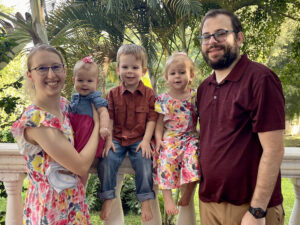
Lorin, Tayler,  Eden, Deacon, Chandler and Enoch Norris

When they are seeing God’s blessings on the field, I jokingly tell BBTI graduates that they are having too much fun, and we must stay here where life is boring.

Tayler and Lorin Norris are certainly enjoying their work in Zambia. Tayler was born into a godly home in the Azores Islands, Portugal. His father was in the United States Air Force. Like many children in Christian homes, he made a profession of faith at an early age. However, as he grew older, he realized that he was not saved. He trusted Christ at age twenty while in Bible college. Lorin was born in Oregon and grew up in a Christian home. She accepted Christ at age twelve. Both Tayler and Lorin were homeschooled.

Lorin’s parents, Jeff and Nanci Klein, came to BBTI in 2007 when Lorin was in her youth. The Klein family served in Argentina, working with the Mapuche Indians for several years. During a furlough, the Klein family met the Norris family, and after a long-distance relationship, Tayler and Lorin married.

When the Norris family felt the call of God to go to Africa, it was natural for them to attend BBTI and obtain the Advanced Missionary Training. They graduated in 2021.They are sent by Coast Hills Baptist Church in Santa Maria, California and assisted through Baptist International Mission Inc.

Their plan was to go to Mozambique, but the Lord redirected them to Zambia where they arrived in April 2022. They settled in the city of Chipata (population 300,000) and began serving with a veteran missionary family.

When Tayler and Lorin began learning Chichewa, they found their BBTI training to be a great help. English is the official language in Zambia, and they became very busy in ministry. Language learning requires careful planning and discipline, and ministry can conflict with language learning. Chichewa is a tonal language. With one tone chimbuzi means “toilet” and with a slight tone change it becomes “big goat.”

God has given the Norris family many opportunities to minister. In August 2022, they hosted a medical clinic in the village of Chiyembekezo where they treated 1,000 people and gave them a Gospel witness. Soon after, they began the Hope Bible Baptist Church in that town. By door-to-door visitation and Bible studies, the church has grown rapidly. Also, Tayler taught in a village Bible institute. This is much needed because, as hard as it is to believe, even some local Baptist pastors would say salvation is gained by good works, keeping the Ten Commandments, and baptism. In January 2025, they began a new church plant, Sunrise Baptist, in Katete, a city of nearly 80,000.

Lorin, besides being a wife, mother, and homeschool teacher, also teaches junior church. Her class started with forty to sixty children but grew to one hundred eighty! Talk about fun! Most Zambian churches have no ministry for children.

Pray for the Norris family. Medical help in Zambia is not always good. Enoch broke his arm. They took him from one hospital to another looking for one with an x-ray machine and a pediatric doctor. Two days later the bones were set. But while in the hospital, the metal curtain rod fell and cut his head.

The Norris’ fun will be diminished this year because they need to come back on furlough to visit supporting churches and new ones to raise more support. Perhaps your church could have them for a meeting. Contact them at: norrisfamilyministry@gmail.com.

Spring 2026

by Tricia Paulichen

Marco and Tricia Paulichen serve in Uruguay

You do not realize how much of life you take for granted until you become a missionary.

Back “home,” you knew how everything worked. Paying bills, getting groceries, tracking down deals? Routine. Booking a doctor’s appointment, navigating paperwork, following traffic laws? Second nature. You knew how to handle emergencies and navigate social situations without thinking twice.

Now, imagine waking up on another planet.

Suddenly, nothing makes sense. The strange one-eyed blue aliens around you speak only gibberish. Their rules are different. Their systems are foreign. What used to be simple tasks now become monumental obstacles.

That is what it feels like to move overseas. You are still an adult, but your brain turns to mush, and you function like a toddler… and often, you are treated like it. Most people back home have no idea.

“When we cross cultures, we leave behind parts of who we are and must rebuild a sense of identity in a new place.”
– Sarah Lanier, Foreign to Familiar

You were once articulate, but now you speak like a caveman with confidence issues. Your ability to communicate determines your independence, and in the early days, you have none. You avoid conversations out of fear, but that slows your progress. The frustration builds—knowing what you want to say but being unable to express it—until you find yourself nodding along just to end the interaction.

Grocery shopping, once effortless, becomes a scavenger hunt. Baking soda? Only sold in pharmacies. Molasses? Available, but in greenhouses as fertilizer. (No kidding.) Opening a bank account requires stacks of notarized documents, multiple visits, and an abundance of patience.

Even something as basic as using a public washroom can go hilariously wrong—like walking in, only to realize, too late, it is being used by both genders as an election voting booth. (Yes, really.)
No one tells you these things outright. You learn through experience, sometimes painfully. And when you misstep, you might never understand what you did wrong. It is trial and error, and each attempt brings a new complication.

Contrary to popular belief, missionary life is not all fun and adventure. Sometimes, it is just exhausting.
You expect an adjustment period, but no one tells you how deep the exhaustion runs nor how long it lasts. Even after months or years, the challenge of culture shock still sneaks up on you. You miss the ease of shopping, the rhythm of daily life, the comfort of blending in. Building relationships takes effort and, even then, you often feel like an outsider. As my immigrant father-in-law often said, “Once you leave your birth country, no matter where you live, you’ll never fully fit in again.”

So why do we do it?

That reality is hard to explain. But underneath the exhaustion is a deeper sense of purpose—one that keeps you going, even when you feel clueless. At first, every day feels like a battle. But slowly, you change. One day, your brain is not fried by 2 PM. Life gets easier. And eventually… you adjust.

Fall 2025

Steve Schnell was born in 1965 in Nebraska to a Roman Catholic family. He tried to be a good Catholic, confessing his sins to a priest and observing the sacraments. He joined the Navy in 1986. He led a sinful life until a fellow sailor confronted him with the Gospel of Christ. He trusted Jesus and became a bold witness. His buddies tried in various ways to tempt him back to his former lifestyle, and he got in “trouble” with his superiors for his bold witness for Christ.

Margie was born in Pennsylvania. Her family roots run deep in the Old Order (Horse and Buggy) Mennonite religion. A friend was killed in a highway accident which made Margie consider death and eternity. Her older brother was saved, and influenced greatly by his witness, she trusted Christ in 1986. Steve met Margie in Tennessee, and the Lord impressed Steve that she was to be his wife. Steve felt he needed the approval of her father, but his friends told him he did not have a chance. He was nervous but passed her father’s test, and they were married in April 1991.

Their plan was to settle down on a farm, work hard, serve God in Tennessee, and live a wholesome life. That plan was challenged by the call of the multitudes living and dying without Christ with little or no chance of hearing the gospel. The Schnells attended New Tribes Bible Institute for a time and also received extensive Bible teaching at their church.

The Schnells graduated from BBTI in 1996. In 1997, with the sponsorship of their church, they became missionaries to Cambodia. The Khmer language was Steve’s first experience at learning a new language, but it was Margie’s third language. With the Advanced Missionary Training (AMT) skills acquired at BBTI, they learned Khmer without attending a language school. They communicated the message of Christ to the Khmer people for several years, started indigenous churches, translated much Christian literature, and produced a radio program that continues today.

The Lord led the Schnells back to BBTI in 2011, and Steve’s experience in the Asian Buddhist culture became a valuable addition to our Culture Class. He has also taught Ethno-musicology and Chronological Bible Teaching. Outside of the classroom, his building skills have been an invaluable help. Margie has cared for students’ children so mothers could acquire the AMT along with their husbands.

It would seem that BBTI cannot function without the Schnells; but it must. Paul received the Macedonian vision, and the Schnells have received the “Slovenian vision.” Peter Marshall, after his first heart attack, was questioned by a friend if he learned anything from his health scare about overworking, and he replied, “Yes, I learned that the Kingdom of God goes on without Peter Marshall.” And the Schnells know that BBTI will go on, too! The 2.126 million people of Slovenia need the Schnells more than BBTI does.

Slovenians are friendly toward Americans. It is a beautiful country with a great part of the Alps in the northwest. Even though the cost of living is somewhat lower than in the USA, it is higher than at BBTI. This means the Schnells need to raise more support. They are currently visiting churches, asking for the prayers and the financial help of God’s people. Pray for an open door to Slovenia for Steve, Margie, and eighteen-year-old Joel who is a current student at BBTI. Their first challenge will be language and culture learning. It has been twenty-seven years since Steve and Margie learned a new language. Pray as they meet this challenge. Thank God for people that will take on new challenges and prove again the faithfulness of God.

Contact info: schnellfamily8@gmail.com

Winter 2025-26

Wil maps out places still in need.

God’s plans and ours do not always coincide, but you must admire missionaries who plan to stay for life! Wil and Trina Muldoon are of this group. They went to the mission field much later in life than most; Wil at sixty-three, and Trina several years younger. Theirs is not a comfortable place but a remote coastal village called Baimuru in Papua New Guinea (PNG). Wil describes their quarterly supply run to the capital: “We travel only by dinghy in our area. When heading into Port Moresby for supplies, we spend an hour going down river to the Gulf of Papua, and then 4 hours on the sea to arrive in Kerema, the closest place we can connect with a road to continue our trip to the city (another six to eight hours). The village grass airstrip has not been open for several years.”

Their village has no electricity. The Muldoons have a generator, but it is very expensive to operate and requires transporting barrels of gasoline ($5.94 per gallon) and a lot of prayer and ingenuity to keep the thing running! How did they arrive at such a place at that time in their lives?

Wil left Vietnam addicted to drugs, disillusioned with religion, and without purpose in his hippie lifestyle. He went west for a simpler life, learned the farrier trade, traveled in a mule-drawn wagon, and also worked as a cowboy. Then, a missionary to the Navajo Indians gave him the Gospel! Everything changed. He attended Bible college, married Trina, and became a missionary to the West and native Americans. Later, he founded a church in Wyoming which he pastored for sixteen years. He was comfortable.He spoke the language and understood the culture. The church was prospering. He could have stayed there.

But he learned from PNG veteran missionary Matt Allen that people in two dozen villages in his area were begging for missionaries to come start a church. But Wil was too old. Or was he? Matt said, “No! Men with age and experience are what we need. Get over here!” So, the Muldoons began at BBTI in 2010. They raised support and left for PNG in September 2012. God led them to a remote, abandoned mission station with fifteen acres of land. They have since developed a unique training program.

Poorly educated, ministry-minded people come as family units and live at Baimuru Baptist Bible Institute (BBBI). They plant and live off of their own gardens and hope to sell extra food for spending money. They work on the property to pay their tuition. Both husband and wife study. BBBI is not a one-size-fits-all program. It is designed to meet the needs of the worker. For instance, they offer a one-year course that includes preparation for Sunday School teachers, youth workers, and invitation counselors. Others will complete two or three years of intensive Bible study and practical training. This is a very heavy teaching assignment for two people, one of whom is seventy-five years old! Besides classroom study, Wil accompanies students to conduct evangelistic and teaching meetings in surrounding villages. God has blessed. Pastors and workers are in places where they are greatly needed. The current pastor of the Baimuru Baptist Church is a 2016 BBBI graduate.

After eight years in PNG, the Muldoons took a seven-month furlough in the States. Wil’s last words to me then were, “I plan to go back and die there.” However, if God gives them life, after this class concludes, they desire to take one more furlough so they can hug their children and grandchildren, meet their new grandchildren, and report to their faithful supporters. But Wil and Trina do believe that Baimuru is where they will be buried. Let’s pray that it will be many years from now! A book should be written about them—probably never will be. But God is keeping the record!

Jordan, Ishmaela, Elroi, Neima, Alicia

Jordan Kurecki and Alicia Ramirez arrived at BBTI in 2017 and could not have come from more different backgrounds. Alicia was homeschooled and raised in a Fundamental Baptist church. She learned to play the violin, interpret for the Deaf, and be an EMT. Jordan came from a totally non-religious broken home in the Chicago area. He attended public school and learned early to play with alcohol, drugs, and a wicked lifestyle. A friend invited Jordan to a Baptist church when he was nineteen. After a time, he trusted Christ. Alicia made a profession of faith in Christ at age four and later, at age fourteen, received assurance of salvation. It took the same grace to save a good girl as it did to save a bad boy! Jordan graduated from Fair Haven Baptist College and Alicia from Faith Bible Institute.

At some point, they noticed each other in our classroom, and the rest is history. At times, we wondered if they were too distracted by each other to hear what was being taught, but apparently not for they have put what we taught them into practice in Uganda. Jordan wrote, “BBTI has made a huge impact in the way I look at missions and has equipped me with a skill set to reach people that many would consider too difficult or impossible to reach!” Here at BBTI, Jordan learned about the Nubi people whom he is targeting. They are a Bibleless Muslim group of Uganda numbering thirty-four thousand.

Jordan and Alicia were married in July 2019 and later that year visited Uganda. They were sent by Park Gate Baptist Church in Ellwood City, Pennsylvania, and began deputation during COVID, the worst possible time. They persevered, making thousands of phone calls and emails. At first, only one in five churches they visited took them on for support, but as they neared their goal, the churches saw their determination, and that ratio improved. They traveled in an old car, and little by little dumped about $6,000 into repairs until the transmission finally quit. It was then that a brother in Christ loaned them a nice car to drive. He “just happened” to buy it on a whim but did not need it. During deputation, Jordan began to study advanced courses in Hebrew and Greek in preparation for Bible translation.

While at BBTI, Jordan met a Nubi man on Facebook who is somewhat of a leader among his people. When they arrived on the field in February 2023, this man introduced Jordan to many people, and he had favor with them—for a while. Later, after he began church services, a large group of angry Muslim men raided a service and beat two of the Christian leaders, one quite severely. Jordan was treated roughly but not injured. The honeymoon was over! Threats and abuse of the church leaders continue. Nevertheless, Jordan and Alicia continue learning the Kinubi language, becoming proficient after less than two years. (There is no language school or professional teacher; they have learned by applying what they were taught at BBTI.)

In May 2023, Jordan discovered a small group of Nubi speaking believers who attempted to translate the Bible into Nubi but had given up because they did not know how to proceed. Jordan has organized and trained a translation team of five Nubis. Recently, they had to dismiss a team member for bad behavior. The man has become a real enemy, trying to extort money from Jordan, threating physical harm and exposure of the team to the Muslims who bitterly oppose a Bible in their language. He would like to get the Kureckis expelled from Uganda. Nevertheless, they plod ahead, making very good progress. There is no time to waste. Despite serious bouts of malaria, threats, and the hardships of missionary life, Jordan and Alicia push the pedal to the medal and move forward!

Winter 2024-25

Carrie Mae Whaley

Carrie Whaley was blessed to be born and raised in a Christian home. She made a profession of faith and was baptized at age four. As an eleven-year-old homeschooler, she was assigned to write about her salvation. Like many who are saved at a young age, she had serious doubts about the validity of her salvation experience. She could not remember what she prayed; she only remembered her baptism. Carrie shared her doubts with her mother who then explained salvation to her. Carrie prayed, asking Jesus to come into her heart and save her. This took care of her doubts for a time, but they returned and stayed with her through her teen years. Had she simply said words to have a salvation experience to write about for her homework requirement? Did she pray because it was what was expected of her? The doubts drove her to her Bible where she learned the meaning of and received the assurance of eternal salvation. Strangely, vivid details of bedtime devotions in her brother’s room came back to her from her experience and prayer at age four. Her mother confirmed what Carrie remembered.

Carrie earned a Bachelor of Science degree in nursing at Western Carolina University and worked as a nurse for seven years. She loved her work but became burdened for the foreign Deaf when she met Dr. David Bennett, director of Silent Word Ministries International. All Carrie knew about the deaf language was the alphabet she had learned from a coloring book at age seven, but at his invitation, she joined a group taking a trip to Liberia and Ivory Coast, Africa.

Upon Dr. Bennett’s suggestion and the blessing of her home church, Carrie attended BBTI. Her pastor described her as a faithful, hard-working church member with special musical talent. At BBTI, she proved to be an excellent student. After graduation, she worked diligently to raise financial support to serve the Lord in Liberia, Africa, and left for the field in February 2024.

She wrote recently, “The honeymoon phase is over, and it is not all sunshine and roses, but I am still having the time of my life!” She is adjusting well to her new country and its language. Pray for Carrie. Her valuable teammate, Monique, was forced to return to the states for cancer treatment, and her future is questionable. Carrie is busy conducting Bible studies and teaching sign language to a group at her church as well as planning a missionary internship/training program. She is making slow but sure progress reaching the Deaf. She is working with BBTI graduates Bruce and Amanda Stewart to prepare a deaf Christmas drama that should reach the large deaf community in Monrovia. The problem is that
Bruce and Amanda live five hours away!
Carrie says that the people are usually friendly, but it is difficult to distinguish between those who are really interested in God’s Word and those just looking for a handout. The well-intentioned generosity of foreign aid organizations has produced many who ask the missionaries, “What do you have for me?” Carrie reports that spiritual warfare there is almost tangible. Even some church members practice witchcraft on Saturday night and then worship God on Sunday. Because of their works-based salvation mentality, they want to placate God so He will give them what they want. They try to “cover all the bases” with both God and Satan. This is not to say, however, that there are no true, godly people; it is just difficult at first to be sure who they are.

Liberians, hearing and deaf, need missionaries! BBTI students, Kyle and Elisabeth Burchwell, are surrendered to go and plan to depart next summer. Could God be calling you to labor there? If you are interested in Carrie’s internship program or just wish to send encouragement, you can contact her at: carrie.whaley@swmi.org

Fall 2024


             Daniel & Libby O’Connor
                  Verity and Eleanor

Daniel O’Connor was born in 1995 in Louisiana, and Libby Mashburn was born in Alabama in 1996. They both came to study at BBTI in 2019 but did not previously know each other. They graduated the following year and were married in April 2021.

Proving himself to be an excellent phonetician, and with a view to teaching Phonetics in 2021, Daniel began helping the out-going Phonetics teacher, Michael Carpenter. Libby easily grasped the linguistic concepts of phonology and morphology. In 2021, she began teaching Phonemics. This year she taught our Morphology class. Both Daniel and Libby are an important part of our linguistics department. The O’Connors wasted no time beginning their teaching career, and neither did they waste time beginning a family. Eleanor Josephine was born in March 2022, and Verity Ruth in September 2023.
Daniel was raised in a godly Chrisitan home and was home schooled. He was influenced by a strong interest in ministry and especially missions. Daniel has had extensive Bible training in his home and church. He was taught to work hard and grew up learning the building trades. Daniel made a profession of faith in Christ at age eight, but at age fifteen, he realized he had only said a prayer, and not trusted in the finished work of Christ for his salvation. After hearing a message on hell, he received Christ.

Libby’s background is much different. She attended a Christian school for only one year. The rest of her education was in the public schools. She graduated from the University of Alabama at Huntsville with a Foreign Language and International Trade major. She learned to be a seamstress and later began making and selling modest women’s clothing. Libby was led to Christ by her stepfather at a young age.

Whereas Daniel’s home was stable and peaceful, Libby’s was tumultuous. Her parents divorced when she was young. Her mother’s life changed when she was saved, and she determined to raise Libby in a godly environment. Other family members believed that she had become a fanatical cult member, and thus began the custody battles. For a time, Libby lived in a home where she learned biblical principles. Other periods were spent in a home that taught and encouraged worldliness. Libby was rebellious but God was longsuffering and victoriously brought her through. She decided to seek and follow Christ. In this world where broken homes and dysfunctional families are almost normal, Libby knows what young people are going through.

Daniel has the desire and skills to help with the much-needed upkeep of BBTI’s facilities but works part time to provide for his family. He wants to increase the family’s level of financial support so that he can teach, help with maintenance, and represent BBTI full time. These are all essential ministry needs. Please contact them at danjoconnor95@gmail.com if you would like them to present their ministry to your church.

The O’Connors desire to serve the Lord on the foreign field. For now, however, they want to invest their time and talents in the preparation of missionary students at BBTI.

Chris and Bonnie Matthews

As a boy, Chris rode church buses to various Protestant and Baptist churches. When he was in his early teens, his family joined a church which taught baptismal regeneration. They baptized him based on an earlier profession of faith, but he had no assurance of salvation. In 1993, at the age of fifteen, he attended a church camp and fell under deep conviction. He pleaded with the counselors for guidance, but they assured him he was okay. That evening, a speaker recited the sinner’s prayer which reminded Chris of the true Gospel he had learned previously. He asked Christ to be his Saviour. Later, he was scripturally baptized and called to preach at Ray Avenue Baptist Church in Salina, Kansas. He attended Bible college for one year and was trained for six years by Dr. Plato Shepherd at Smoky Valley Baptist Church in Lindsborg, Kansas. Chris served as an associate pastor for three years, and in 2005, he became the pastor, serving until 2018. He also became a firefighter and an Emergency Medical Technician. He taught both EMS and CPR.

Bonnie was raised in the home of a godly pastor. She made a profession of faith at age four, but like many children, she later had doubts. It was not until she was a pastor’s wife that she received full assurance of her salvation. She graduated from Calvary University in Kansas City with a bachelor’s degree in Elementary Education. She was a pastor’s wife for fifteen years. She has taught music, written and led ladies’ Bible studies, led youth ensembles, spoken at ladies’ conferences, written historical novels, and taught piano. Bonnie has training and field experience in Teaching English as a Second Language.

The Matthewses could have easily continued serving the Lord in Kansas, but God began to burden their hearts for a very restricted country in Southeast Asia. Upon hearing this, people began telling them that they needed to attend BBTI. Shortly after arriving in 2019, they fell in love with our school and could see how it would benefit them on the mission field. Even while they were students, Chris envisioned returning to BBTI one day to help train missionaries.

In less than a year after graduation, the Matthews family arrived on their field. God gave them a very fruitful ministry in evangelism and leadership training. They were having the time of their lives! They loved the place and especially the people, and the people loved them. They often saw God protect them and provide miraculously. One such time was during the strict COVID lockdown when they needed to return to the US for the impending death of Bonnie’s dad. They were not allowed to leave their neighborhood, but they had to obtain their passports from another part of the large city. Couriers could not get through the military/police checkpoints, but Chris rode his motor scooter unhindered through every checkpoint without even being stopped!

Chris and Bonnie were not looking for an easier place of service or greener pastures, but God was impressing their hearts that they needed to labor at BBTI. Rex Cobb had previously told Chris that BBTI would soon need a younger director. After much fasting, praying, and seeking counsel, they contacted Brother Cobb, other staff members, and our sponsoring pastor, Steve Summers. No snap decision was made, but all involved, including the school trustees, believed that Chris was right for the job. He will officially become the director at graduation on May 18th. He plans to make trips back to his field to train church leaders and help oversee a Bible translation project. Chris’ leadership experience and Bonnie’s many skills will help move this ministry forward in the days to come.

Spring 2024

Part of the application process for enrollment in our Advanced Missionary Training program is a recommendation from the pastor of the applicant. Doug and Lisa Nispel applied for enrollment at BBTI in 2014. One question we ask the pastor is, “What is the applicant’s greatest strength?” For Doug, he answered “faithful” and for Lisa “compassionate.” We found the pastor’s description of them fully accurate. As students, they were a constant joy to us, along with their two daughters, Abigail and Elizabeth. They worked diligently both in the classroom and during our afternoon Work Detail.


Doug was a bus kid. His parents sent him to Red Lion Bible Church and his grandmother paid for him to attend the Christian school until the sixth grade. He heard the Gospel many times and was saved at the age of eleven. Doug lived for God for a time but became tired of feeling like an oddball and not having any friends. He decided to go his own way. As is always the case, this led to some poor choices. Even as a preteen, he began using the marijuana and alcohol that he had access to at home. However, God did not give up on Doug. When he was nearing the age of twenty, his father was gloriously saved. The booze and drugs left the home, and his father began serving the Lord. (Today he has a truck stop ministry). This had a convicting influence on Doug, and at the age of twenty-one, he surrendered every area of his life to God.


Lisa was raised by good, religious parents in a Methodist church. Then came the day when the pastor distributed to all a copy of the Good News for Modern Man and announced that it would replace their Bible. Her father had enough discernment to leave the church, and the family began attending Red Lion Bible Church. Lisa was led to Christ by a faithful Sunday School teacher who used the Wordless Book to teach the Gospel. Lisa’s father and mother began a bus route. Together, they serve faithfully in that ministry until this day.


The Nispel family arrived at BBTI in 2015 with the desire to serve the Lord in Romania. They continued raising support as students and graduated in 2016. In March 2017, less than a year after graduation, they arrived in Timisoara, Romania, and began learning the new language and culture.


A big part of the Nispel’s ministry is training believers in evangelism. They serve primarily in five or six Baptist churches, helping with outreaches and training the believers to use different methods of evangelism and tract distribution in outdoor and public settings. People are receptive and willing to listen but slow to trust Christ. Doug and Lisa look for outreach opportunities such as carnivals or festivals. They incorporate the use of Christian films in their open-air meetings. In the summer, they assist several different Baptist churches in vacation Bible school outreaches in places where there are thus far no churches.

When the Iron Curtain was torn down in the early 90s, Gospel seeds were sown in Romania and other Eastern European countries. It produced a great harvest for people who were hungry for prosperity and freedom. Thank God, that many missionaries went. Sadly, many stayed only a short time. There is, no doubt, a great need for new, church-planting missionaries in Europe, but there is also a great need for missionaries such as the Nispels who will take up the unfinished task of training believers to reach others.


Compassion took the Nispels to Romania, and faithfulness keeps them there!

Winter 2023-24

Marco Paulichen Family
Missionaries to Uruguay

Marco Paulichen was born in Calgary, Alberta, Canada in 1978, and his wife Patricia was born in Ontario a few months earlier. But two could not have come from more distinct backgrounds.

Marco’s mother was from Argentina, and his father was from Uruguay. Marco’s first language was Spanish. His parents were devout Christians and raised Marco in church where he heard the Gospel often. At age five, his Sunday school teacher led him to Christ.

Patricia’s mother was an unsaved, single mother who left Patricia soon after her birth. Though she eventually returned, Patricia grew up in broken homes feeling unwanted and unloved. By age twenty, she was using drugs daily and attending drinking parties each weekend. By the grace of God, Patricia was given a gospel tract by a street preacher. It showed her that she was lost and on the way to hell, but she did not know how to respond. She asked her friends about the way of salvation, but none of them could help her. She tried self-reformation, attempting to please God. This only led to deep depression and thoughts of suicide.

Patricia was in an office building for a job interview when she literally bumped into the young electrician working there. She gladly accepted his invitation to attend his church: later he led her to Christ on their first date. Her life changed drastically; she was a new person. Eleven months later, she married that young man! They have been serving the Lord together for twenty-four years.

Marco and Patricia felt led of God to go take the Gospel to Uruguay. Along with their teenage children Josh and Josephine, they attended BBTI from August 2017 until May 2018. Josh and Josephine studied BBTI classes in the morning and worked on their homeschool assignments in the afternoon. They all excelled. Marco, a master electrician, made many needed electrical improvements at BBTI.

In October 2018, the family arrived on the field prepared to learn the language and culture of Uruguay. Because of Marco’s paternal roots in the country, he and his children are allowed dual citizenship of both Canada and Uruguay. Patricia has been granted residency. They do not struggle to obtain visas like many other missionaries; they are allowed to travel in other countries of South America without restrictions. The children are also entitled to educational benefits. While in Canada, Josh and Josephine studied music at the Royal Conservatory, and in Uruguay they were admitted into a classical music conservatory. This has resulted in many good contacts for the family’s church planting ministry in the interior city of Salto.

Having never lived in Uruguay, Marco has had to learn the country’s unique Spanish. He was able, however, to soon begin the Iglesia Bautista Fundamental in their home. The church began in the living room, kitchen, and under the carport. God blessed and the church grew. They currently meet in a rented building but are looking for a building in a better location. Marco preaches on the radio five days a week and sets up a literature table in two open-air markets where he witnesses for Christ. Thank God that the Paulichen family is faithfully giving the Gospel to the lost in their city. However, many more missionaries are needed for the places where the people wait for someone to bring them the Good News. Pray for laborers for Uruguay and the surrounding countries. Remember that the Gospel is not Good News if it gets there too late!

Cindy Stacy
Missionary to Zambia

Cindy Stacy is not another Mary Slessor. She does not trudge alone through the African jungles facing the danger of lions, cannibal tribes, and pythons. (She does need to avoid contact with black and green mambas and other venomous snakes). Much of what she does as a missionary in Zambia is what she did for many years in New Mexico.

On March 24, 1964, Cindy was born in Santa Fe, New Mexico. Eight years later, she was born again at Temple Baptist Church. After graduation from the Temple Baptist Christian School, she earned a bachelor’s degree from Eastern New Mexico University.

Cindy joyfully served the Lord in her highly active church, Gospel Light Baptist, in Rio Rancho, New Mexico. She taught in the Christian school for twenty-three years. Why did she not stay where she was comfortable and safe? She was drawn to Zambia because she saw a much greater need there. Of the 13,800,000 people in this Southern African country, half are under the age of fifteen. Cindy saw wide-open doors and opportunities. A church-planting missionary family needed her experience and expertise. Though most of Cindy’s peers are willing to serve the Lord in the United States, few of them want to go overseas. However, Cindy was willing to serve outside her comfort zone. Instead of asking, “Why should I go?” she asked, “Why should I stay?”

Mission work requires preparation. Once Cindy’s church commissioned her as their missionary, she began presenting her plans to other churches. Knowing full well what children need, she began asking God’s people for school supplies to take with her to Zambia. They responded generously to the need. Cindy also began saving for passage and setup expenses. A single missionary may require a smaller amount of monthly support, but plane tickets, visas, housing, furniture, and vehicles are expensive. Cindy worked diligently. Seeing the benefits of BBTI’s Advanced Missionary Training, she arrived for training in August 2014, graduated in May 2015, and left for Zambia in January 2017.

English is not the first language of Zambian young people, but they need to learn it. Cindy teaches grammar, reading, and ESL classes to the youth. She has Thursday and Friday evening Bible classes for neighbor children and conducts a successful Children’s Bible Hour on Saturdays. Cindy enjoys teaching her Sunday school class of seventy-eight children as well as discipling ladies.

Missionary work is not simply teaching people but training people how to teach other people. Through the Solid Rock Bible Institute, Cindy is training two young ladies to be future teachers. Though they are not allowed to have their own class in the church before they graduate, they have begun a neighborhood Bible class on their own. One lady asked Cindy to teach her four children to read. Instead of teaching the children, Cindy trained the mother to teach her own children. The team wants the young people to have Bibles, but they do not simply give them out. The children must earn their Bible through the Faithfulness Campaign which requires church attendance and Scripture memorization.

While church and school duties keep Cindy very busy, she still finds time for her cat, dog, and vegetable and flower gardens. Zambia, like many places, has its share of difficulties, and Cindy must share those difficulties with the people she loves. Often there is no daytime electricity, and water is very scarce. Prices have increased by seventy-five percent, and, of course Zambia was plagued by Covid-19. Nevertheless, Cindy is very content and does not want to be anywhere else! She extends this invitation: “If you’d like to come work in Zambia, you can teach the two-to-seven-year-old children. I will give you thirty children, chairs, a room, the curriculum, a helper, and all the hugs you’ll need for the rest of your life.”

Winter 2022-23


Charles V. Turner in 2021

Charles V. Turner was born in Greenville, South Carolina, in 1934 and born again in 1951 at a summer camp ministry of Marcus Hook Baptist Church in Pennsylvania. It was at this church that he dedicated his life to the work of missions in 1952. The following year, he enrolled at Columbia Bible College and graduated in 1957.

Classmates of Charles were Wanda Sifford, Mary Lou Pruitt, and Joshua Crocket. Charles married Wanda and they served the Lord in Papua New Guinea as missionaries with New Tribes Mission. Joshua married Mary Lou, and they were home missionaries helping struggling Native American churches.

Charles was busy in 1957. He finished Bible College, took the Summer Institute of Linguistics (SIL) course in Norman, Oklahoma, got married, and began training with New Tribes Mission (NTM). No sense wasting time when you know what God wants you to do! During summer vacation of 1959, while still students at New Tribes, the Turners returned to Norman to re-take the SIL training.

In 1960, after six years of formal training, the Turners were sent by Marcus Hook Baptist Church to Papua New Guinea where they served until 1980. First, Charles and Wanda learned the trade language, Tok Pisin. Then they learned the unwritten language of the Sinasina tribe. Applying the linguistic skills, they learned at SIL and NTM, they developed an alphabet, giving the language a written form. They produced literature and taught the people to read. In 1975, they completed the translation of the New Testament. After several years of use in the churches, Brother Turner and the church leaders revised and improved the Sinasina scriptures. For twenty years, Charles and Wanda spread the Good News, baptized converts, taught literacy, and began four or five churches and a Bible institute. In recent years, the work has flourished, and many more churches have been established in the Sinasina area. According to family members and medical experts, Wanda should never have gone to the mission field because of a heart condition. However, she did go and was a good missionary/linguist. In 1975, Wanda had open heart surgery, and then returned to the field.

In 1980, the Turners returned to the NTM training center where Charles taught Bible translation, linguistics, and language and culture learning. He began writing the book Biblical Bible Translating. In 1982, they transitioned to Baptist Bible Translators Institute (BBTI). They took the BBTI training which was a review that prepared Charles to teach the same courses at BBTI. In 1991, he became the director of BBTI and served in that position until 2005.

Wanda passed away in December 1994. Later, Charles married Mary Lou, whose husband, Joshua had died a few years earlier. Mary Lou took the BBTI training and served the Lord and the BBTI students. She went to be with the Lord in November 2020.

Charles desires to visit the Sinasina people again; pray that his health will allow it. He currently serves the Lord as a BBTI trustee, a deacon at Truthville Baptist Church in Truthville, New York, and a teacher in their Christian school. Servants of Christ may change locations and job descriptions, as Brother Turner has, but when he signed on, it was for a lifetime of service.

Fall 2022


Students' Corner

Student Profiles

Matt & Anna Risinger Janica & Abraham

I had the privilege of growing up in a Christian home and of being saved at a young age. Around seventeen years of age, the Lord did a reviving work in my life. For the first time, I began to understand that Christ Himself was the answer for victory over sin. At that time, the Lord also gave me an opportunity to take a month-long mission trip to Kenya with two other young men. One week we devoted much time to witnessing to people on the street. I see this as a time of God pouring fuel on the fire of what He was doing in my heart. Since then, I have wanted to be a missionary in Africa, and I believe this desire came from the Lord (1 Tim. 3:1).

The choice of Cameroon has been a process. While I was in Bible college, there were a few young men that seemed to be considering missions in Cameroon. I thought, “There are other countries in Africa that need missionaries. We do not all need to go to Cameroon!” In 2024, we traveled to Burkina Faso. It seemed that the Lord had allowed some things to point us in that direction, and surely, He had His reasons for allowing us to go at that time. After seeking the Lord, we decided that Burkina was not the place where we were to stay for long-term ministry.

By faith we went through the next open door: Cameroon. We have connections there since my wife grew up in that country. After spending basically the first half of 2025 in Cameroon, we can testify that (1) the Lord has truly begun a great work in that country; but (2) there are so many more cities, towns, and villages still in need of the Gospel and Bible-preaching churches; and (3) many Cameroonians in this generation, even Muslims, are open to listening to the Gospel. A veteran missionary in Cameroon likes to say, “The doors in Cameroon are so wide open the hinges have blown off.” There is indeed a great need in Cameroon for many more laborers.

We believe the next step the Lord has for us is to return to Cameroon. Based on my experience and the testimony of other missionaries, Africa in general is ripe for Gospel labor at this time. The question is, will this generation of Christians obey the Great Commission and take advantage of the window of opportunity God has set before us, or will this be a wasted harvest? The labor will not be easy, but the Lord is able. Will we send and go?

Spring 2026

by Janelle W.

A younger Janelle dressed
for a mission conference

My childhood was saturated with God’s Word and biblical instruction. I believed on the Lord Jesus as a child and since then have desired to serve Him in foreign missions. I dreamed of being called to Africa. While in Bible college, my eyes were opened to unreached and often avoided nations shackled and blinded by Islam. I volunteered to go and bring light if God would allow. 

Through the years, God has given me the opportunity to minister short term in several countries around the world which further strengthened my desire to go where “Christ has not been named.” After each trip, I asked God if He wanted me to return and serve in that country.
I was unsure if and when the Lord would allow me to enter into foreign missions, so I determined to help prepare the next generation of missionaries under my influence. For the last several years, I have had the amazing opportunity to teach God’s Word to children in our church, school, and community. 

In the last few years, God opened the door for me to take a trip to the Middle East and another to North Africa. I was able to see firsthand the lack of access to the Gospel. I watched people react to hearing the truth spoken in love. I met young believers who have had a fraction of the exposure to the Bible that I have and how they have endangered their lives to receive more truth. I saw people waiting for light.

After my trip to North Africa, I began praying about the possibility of taking God’s light there. While teaching through Hebrews 11 in my Bible class over several months, God confirmed in my heart that this was the step of faith I needed to take. It is impossible to please God without faith. God is pleased when we believe that He will do what He said He would do. When Abraham was called to a place he could not see, he believed God and obeyed. He believed that God WAS able and WOULD keep His promises. Philip left a city in revival and ran to the desert at the Spirit’s leading. He opened his mouth and shared Jesus with one man that would reach others in Africa. God desires that all people come to Him in faith, and I believe that God can use anyone … including me.

Would you pray with me that God would send laborers to North Africa? Jesus told us to pray for laborers and He told us to go! God wants all of us to be involved. How could God use you to change someone else’s story for eternity?

Winter 2025-26

Michael Shaver Family

I was born into a Christian family. One day, when I was ten years old, my relatives gathered all the kids in their living room. We sat down and waited. Then my cousin got up, stood behind a chair, and began preaching a sermon… AS A YOUNG TEENAGER!!!! I was blown away! It had never crossed my mind that a young person could be a preacher. From that moment forward, that is what I wanted to be.

Months later, our new church had its annual missions conference where thirty-five missionaries presented their works. The fellowship hall was filled with missionary displays representing the need in all corners of the earth. I was attending the Christian school and in every class a missionary told of their field and their burden to reach it for the Lord. Again, I was blown away. From that moment forward, I wanted to be a missionary.

That desire remained all through junior high and high school. I began college, majored in missions, and was burdened for many places. I graduated with a strong burden for India but had no peace about going anywhere.

I got married and the Lord very clearly moved me to a church in Kentucky. No paid position. Not even a promise of a position. Just a clear, “Go and serve.” So, we went. After five years, the Lord opened the door for me to take a paid position at the church, and I continued the roles I had already been filling. During this time, God gave me a lot of perspective and matured me.

During another missions conference, two years later,the Lord again stirred me. I told another staff member, “Pastor better stop preaching on missions or I’m going to the mission field!” Four months later, I knew very clearly that God wanted us in missions. When I approached my pastor, he said, “That’s wonderful! Where?” I looked at him and said, “I don’t know.” He replied, “That’s ok. If you don’t have a Where then pick a Who.” He began to list some quality missionaries, but I said, “Honestly God has already put someone on my heart.” (It was a cousin I was sitting next to on the floor when I first saw a young person preach.) Missions was on his heart as well but he had not yet confirmed it with the Lord. My pastor sent me to talk to him, and He told me he had been asking the Lord for a partner. Through prayer, God soon confirmed that we were to take the Gospel to Iceland as a team.

Spring/Summer 2025


Kyle and Elisabeth Burchwell

I was privileged to grow up in a Christian home. After my salvation at the age of four, the Lord called my father to preach. He left his career and moved our family to North Carolina to attend Ambassador Baptist College. His example of faith and obedience continually challenges me.

Growing up at a Bible college afforded me many privileges. At an early age, I encountered the idea of serving the Lord with my life in ministry. When I was twelve, I gave my life to God at a summer camp. I did not know anything about ministry, but it made sense that if Jesus was willing to die for me, I should be willing to live for Him. My mother did all she could to encourage this decision, and men and women of God from yesteryear were often the assigned topics of reading assignments and school reports. Missionaries became my heroes. Two years later, I told the Lord that I would do anything and go anywhere for Him, including following him to the foreign field as a missionary.

Being around a Bible college, however, was not always positive. My father was a deacon at a church whose pastor was a college staff member. The pastor disqualified himself and split the church. The spiritual damage caused by this scandal led me to turn my back on God and the ministry. I renounced my surrender and charted my own course.

After high school, my parents pressured me into taking a one-year Bible course at Ambassador. I was bitter, miserable, and under constant conviction, knowing that I was running from the Lord, but He continued working in my heart. That semester, God put me through a series of events that brought me back to the place where I realized that a life outside of God’s will was not a life I wanted to live. I rededicated my life to the Lord, changed my major to Missions, and began to seek and follow God’s leading.

When the time came for my missions internship, I chose to pursue several opportunities that piqued my interest and prayed for the Lord to give me guidance. He closed the doors on all of them. Then, through a series of Divinely orchestrated circumstances, he steered me to a unique opportunity in West Africa to minister in Ghana, Liberia, and the Ivory Coast. On this trip, the Lord burdened my heart for Liberia. Afterwards, he confirmed this calling to my wife and me through answered prayers and further opportunities. We are excitedly anticipating our first term in Liberia next year.

Winter 2024-25

                   John and Lena Allen

I was saved in my high school years. Immediately after graduation I joined the military, and a few months later I married my high school sweetheart (who is still my sweetheart and ministry partner forty-seven years later).

While stationed in Germany in 1980-81, we had part in planting a church for US service members. There we met our first missionaries, John & Alma Bettig, who served with Trans World Radio, recording and producing Russian language broadcasts to beam into the Soviet Union. After they spent an afternoon telling us of their twenty years of work in this ministry, we were moved in our hearts with both the responsibility and opportunity to share the Gospel of Christ with the world beyond us.

In 1981, after completing my four-year military tour, we moved to our present home church in Louisville, Kentucky, and became more involved in ministry and missions. Starting in 1991, I was able to take short-term trips to Eastern Europe and Russia to teach in Bible institutes and to preach. In 1999, we began taking yearly trips to Mexico with our church.

When I became pastor of our church in 2001, we were able to focus on missions through increased giving, more mission trips, and sending out our own. In 2003, we sent our son Matt and his family to Papua New Guinea (PNG). He was the first missionary sent from our church who grew up in the church. It meant much to our people.

My wife and I visited PNG in late 2005, and while we were there the Lord directly moved in our hearts that PNG was where we should be. We didn’t see it coming—after all, who follows their son into the ministry? The needs were for someone to learn the unwritten Kamea language with a view to translating the Bible, and for someone with medical experience and gifting to serve the people with a medical clinic. Those were a perfect fit for my wife and me (now empty nesters). I had always enjoyed working with other languages and had a burden for Bible translation; and my wife was a registered nurse with varied experience.

A few months later we resigned our positions and moved to Bowie, Texas, to begin training at BBTI. We are now in our seventeenth year in PNG and use lessons we learned at BBTI almost constantly.

Summer 2024

Our call to the mission field started when a ministry in Romania, supported by our church since the early 1970s, asked if anyone wanted to help on a construction project. I did not have any vacation time, a passport, or even a way to financially go. I told the Lord that if he would provide the way, I would go. He did provide! While in Romania, I passed out tracts and churches invited me to preach. After that trip, I knew the Lord would eventually have me go into missions but did not know where or when. I knew I needed to wait on the Lord to show me where he wanted me to be and when I was to go, so I remained active in our home church by serving in the bus ministry, jail ministry, nursing home and anywhere that I could help.


I met Lisa in 2001. On our second date, I told her that I believed the Lord would have us on the mission field, and that if she were not willing to go, we should not continue our relationship. Being close to her family, she did not automatically say yes, but did say she would pray about it. That night, sitting in her car before going into her third shift work, she looked up at the sky and thought of all Jesus had done for her. At that moment, she knew. If missions was what the Lord had for her, He would help her through it. Lisa let me know she was willing to go, and we married a year later.


I had been going to Romania on mission trips every two to three years since the year 2000. In 2007, while on one of those trips, I realized that I was ready to stay. The desire in my heart to be in Romania was honestly more than the desire to be in America. I became sure of the call to go.
I tried to schedule meetings and look for a mission board, but every door I tried was shut. I waited on the Lord, asking Him to open the door and make it obvious when it was time to start the deputation process. In 2012, the Lord answered that prayer in specific ways, showing us it was time for me to quit my job and go on deputation. We started full-time deputation with little support, but God answered prayer and provided a place for us to stay. I knew God would take care of my family.


In 2014, the Lord led us to BBTI to prepare for the mission field. It was hard to wait on the Lord to open doors in his timing instead of mine, but God’s timing is best. He used our lack of support to prompt me to contact churches in other states and keep me in America long enough for missionary training. At the right time, he gave us the support we needed, and we went to Romania.

Winter 2023-24

Bro. Ed Waddell
hewj1261@gmail.com

In January 1990, during a Sunday morning service at First Baptist Church of Mayport in Mayport, Florida, God saved me, a twenty-eight-year-old Navy electrician, under the preaching of a guest preacher. At that time I was stationed at Mayport Naval Base in Jacksonville, Florida, serving aboard the USS Saratogo CV-60.

In 1987, aboard the submarine USS Mendell Rivers, my right hand and arm were injured in a machine accident. I served for seven more years, receiving an honorable discharge and a partial disability after twelve years of service. God’s timing and ways are ALWAYS perfect (Romans 8:28; Philippians 1:6; 2 Timothy 1:9). Doing my best to trust and obey according to Proverbs 3:5-6; 16:3; Philippians 3:13-14; & 2 Peter 1:10, I have served God in my local church in whatever ministry capacity He has given me.

This was never more important than in August 2021 when God answered my prayer for strength to end the grieving process after my wife died from cancer in March 2021. God used a missionary family who visited our church to turn my attention toward the mission field and show me that I should be personally involved in missions.

God pointed me directly to the Advanced Missionary Training that I am now completing here at Baptist Bible Translators Institute. I knew about BBTI from their radio program on the Fundamental Broadcasting Network and from seeing Rex Cobb’s articles in the devotional booklet, Baptist Bread. So, I moved from Charleston, South Carolina, to Bowie, Texas, to begin preparing for the ministry the Lord was leading me to. On September 21, 2022, at East Side Baptist Church in Bowie, I met a native Navajo missionary, Aaron Nelson. God showed me how I could also serve as a missionary to the Navajo Nation. I saw the great need for indigenous Bible-based churches that have an accurate, textually pure copy of God’s Word in their native language.

Please pray for me as I move forward in the direction God has given me and begin serving in this capacity (as well as in any others that are necessary).

From the Navy to the Navajo: God is good!

Winter 2022-23

Madison, a graduate of Pensacola Christian College, currently studies at BBTI.

By Madison Lehman

Why do missionaries go? Why do they stay? Why do believers risk their lives? Why do martyrs die? We have all heard that the need for lost souls to hear the Gospel is great; and the need is great! In fact, the need is numbing. However, the answer to these questions is not the need. Those who embrace the need struggle to maintain their zeal, while those who suppress the need struggle to minimize their indifference. So, the questions remain.

I heard a man answer these questions on Voice of the Martyrs (VOM) Radio. He said, “They do not go because the need is great. It is. But they go because God is worthy.” When I heard that, God pierced my heart! I serve the same God. Isn’t God worthy of my complete surrender and obedience?

I have heard about the need my whole life. Growing up overseas, reading VOM and Open Doors magazines, collecting missionary books, and hearing missionary testimonies continually kept the need fresh in my mind. I told God that I would go. Then, I told Him that I could not go. God gave me a taste of missionary life, and I shrank back. But last fall, He began convicting me of my need to yield to Him. God showed me that He is worthy of my obedience—at any cost to myself. He broke me and called me with Acts 26:16-18. By God’s grace, He will not let me be “disobedient to the Heavenly call” (v. 19). God has specifically called me to minister to Arab Muslims. I do not know many things, but I do not have to know to obey. I must obey.

The need alone is insufficient motivation for any missionary or ministry. God alone is The Motivation. I am not going because the need is great. I am going because God is worthy. God promises to save souls (Isaiah 45:3), but God doesn’t promise that I will get to see Him save souls. I may minister my whole life and never see one soul saved. Or I may die. If I live, I shall live unto the Lord; if I die, I shall die unto Lord; whether I live therefore, or die, I am the Lord’s (Romans 14:8). God alone is worthy of my life.

“This year, will you follow Christ, or will you ask Christ to follow you?” (Dr. David Jeremiah). Your answer to God’s call will change your life. My answer is changing my life.

Fall 2022

Cassie, James, Emily, Melana & Lilyanna Dean love life in Siberia

By James Dean

At age thirteen, under conviction of sin, I repented and placed my faith in the Lord Jesus Christ, believing that His blood alone was able to save me. A few years passed and I began to grow spiritually. During the summer before my freshman year of high school, the Lord started to deal with me about going into the ministry. I did not respond to the call at first, because I felt unable, not possessing great oratory abilities. God showed me that is just the point; we are unable, but God is able. The ministry is such that we must rest in the power of God and not our own natural abilities. The Holy Spirit continued to deal with me. I yielded and upon completing high school, went to Bible college.

While attending Midwestern Baptist College, a chapel speaker came and presented the need for missionaries in the arctic regions. He spoke of the many distinct groups of people within the circumpolar region. One of the people groups mentioned was living in northern Siberia, Russia. During his presentation, the Lord broke my heart for the arctic people. I did not want to mistake God’s will, but clarity came as I prayed for direction. The Lord wanted me in the arctic, particularly Siberia. Unbeknown to me, during that same chapel service, the Lord dealt with my future wife about missions in the far north. Upon completion of Bible college, we married, and I returned to the Ohio Valley to work in my home church as my pastor’s assistant before beginning deputation.

During our final stages of deputation, we attended the Baptist Bible Translators Institute (BBTI) where my wife and I spent nine months studying linguistics, culture, and missions. We are so thankful for the training we received. At the time of this writing, we have been on the field for over thirteen years. We have studied language and collaborated with veteran missionaries in both children and village ministries. We are currently beginning in a fledgling work in a northern village with the goal of planting an indigenous church.

Summer 2022


Jessi Pontius

Growing up in a Christian home, it was easy for me to realize as a child that I needed to trust Christ with my eternity. Trusting Christ with my life, on the other hand, was not so easy.

God first dealt with me about surrendering my life to Him when I was eleven or twelve years old. I had been reading my Bible (a habit I was still trying to start) when I came across Isaiah 6:8, “Also I heard the voice of the Lord, saying, Whom shall I send, and who will go for us? Then said I, Here am I; send me.” I had never heard God speak to me from His Word in such a way, and I really did not understand what the verse meant. I knew it was very important, but I did not see how. I had a slight feeling that this was God calling me to the mission field, but I denied it and moved on.

As I grew older, I realized what God was saying through that verse. Still, I denied it, convincing myself that God had not called me to the mission field.

Around the age of sixteen, I decided I was going to go into the Lord’s service—as a paleontologist. I wanted to show through fossils that God was Creator. Although a very nice plan, it was not God’s plan for my life. God brought this squarely to my mind through the passing of a loved one a year or so later. I had never felt the reality of death quite so strongly until that time. It made me wonder about the eternity of those who have never heard the Gospel. God showed me through that trial that although Creation ministry is good, His plan for my life was to be a missionary. I was finally ready to say what I had read a number of years before: “Here am I, send me!”

God first led me to Massillon Baptist College and has now placed me at Baptist Bible Translators Institute to prepare me for the mission field. Ever since I surrendered my life fully to God, He has only strengthened the desire in my heart to share His love with those who have not yet heard. Where God will finally lead me, I do not know, but I am so excited to see His plan unfold. All I can say is, “Here am I! Please send me!”

Spring 2022

Cliff and Mary Middlebrooks are sent from Redemption Baptist Church in Decatur, Alabama. cwm1611@gmail.com

by Cliff Middlebrooks

I had thought that missionaries were an extinct species who had all died off in the day of David Livingstone. But shortly after the Lord saved me, I met my first real, live missionary! Then, while serving a tour of service in Korea in the Air Force, I asked people in America for the names of missionaries that might be in my area. Every time I had leave, I took the bus as far as I could and then hiked back into the mountains of Seohae-Dong to help a missionary who operated an orphanage for the Deaf. After separating from the service, I laid a map out before the Lord and asked Him to send me to the Pacific Islands as a missionary. His answer was a resounding “no.”

My wife Mary and I busied ourselves in the work of the Lord. Over the last forty years we have served in many different capacities. We always sought to do what God led us to do as He led us to do it. Each time our ministry and focus changed and we asked the Lord, “What would you have us to do?” it was always preceded with, “May we go to the mission field now?” His answer was always “no.” However, we took young people on short term mission trips. As our son and several students that we had taught over the years surrendered their lives to the mission field, we resigned ourselves to the idea that perhaps the Lord felt a better use for us was to train others and send them off to serve on the foreign field.

After pastoring for a number of years, we found ourselves at the same ministry crossroad. This time, when we asked if we could go to the mission field our hearts began to be convinced that the answer was yes! (At first, we did not admit it to each other for fear the other would think we had lost our minds!) We needed confirmation that this was truly the will of the Lord and not our own desire. So, without saying much to anyone about why we were going, we went to Nicaragua seeking for answers. And God did answer!! He opened door after door and began to lay detail after detail in place for us. Some people have called us crazy for going to the mission field at our age when most people are thinking of retiring. We call it the greatest privilege of our Christian lives.

Winter 2021-22

Rachel, Nate, Sophie, Theodore, Delbert, Cory,and Myles nicelandshavers@outlook.com

by Nate Shaver

The first missionary family I remember meeting was going to England. I was four or five years old, and they had come to our house for dinner. My parents, desiring to influence their children towards missions, regularly hosted missionaries, and I remember having missionaries to Mexico, France, Philippines, Australia, Russia, and other places coming over to eat. I was eleven when, during our church’s missions conference, I met a missionary who was going to Iceland. I spent the entire week at his table asking him questions, and God planted the seed for Iceland in my heart.

Years later, the Lord began directing me and my wife to move from our place of ministry. Since I had already wanted to be a missionary for twenty years, we immediately started praying for clarity with a focus on missions because where we were serving, a Baptist church was located every couple of blocks. God was bringing the need for Iceland into focus. There is only one missionary and one work in a country the size of Kentucky. As we started to feel God leading in that direction, we prayed for open doors if it was God’s will for us to go there, and for closed doors if it was not his will. We were excited to see God make obvious his will for us to head to Iceland.

It is special to see how God specifically worked to bring me and my wife to this place of being missionaries. I know for a fact that missions conferences, having missionaries in our homes, long distance correspondence with missionaries, and going on missions’ trips all had an impact on us. Our children will grow up in Iceland as “missionary kids,” but that will not automatically make them aware of their responsibility for reaching the world for Christ. It will be the emphasis and focus we put on the task that God has given us that will keep their eyes toward the uttermost. We are excited to raise our children on the mission field, and although we do not know exactly what will happen, we do know it is exactly where God wants us to be.

Spring 2021